

In an article written on March 31, 2021, it was submitted that Operations Research (OR) could have a significant contribution in dealing with the problems of Covid-19 specially with respect to bed allocation in periods of extensive demand. We recall that OR is used at the operational level in decisions for resource allocation, management of supply chain, job/staff scheduling, inventory control amongst others.
Worst-case scenario of a thousand COVID-19 patients was mentioned as something we hoped we shall never reach, little knowing that the situation will turn into a nightmare, whereby hundreds will die, and thousands will be infected. This is most unfortunate. Could this situation have been avoided, or at the very least mitigated?
We would argue in the affirmative.
At the outset it was mentioned that “guaranteeing the rehabilitation of treatment of people suffering from serious chronic illnesses was important.” However, the situation at the beginning of this year of nearly a dozen dialysis patients dying as a result of cross-infection could have been avoided if the appropriate measures had been taken to prevent infection from happening within the hospital.
In the present state of staff « burnout », it is fair and reasonable to raise questions as to why appropriate shifts to doctors and nurses have not been carried out. Staff planning as per OR approach could help avoid such a situation.
Vital oxygen supply to hospitals from a policy decision perspective does not seem to have put the life of the patient at the centre of decision-making. Rather party business politics is what seemed to have prevailed, thereby leading to lack of supply and an emergency situation.
Hence, it is legitimate to enquire whether the increase in the rate of fatalities can be attributed to policy decision deficiency?
Purchase of ventilators suffered from the same causes.
Changes as in terms of triage proposed in the first paper has been partially implemented. However, home care service delivery did not operate at its optimum level. Hence, instead of seeing a flattening of the curve, that is a lessening of the incidence of the pandemic within the community, it was the very opposite that occurred.
We nevertheless concur that the situation is not easy as it looks.
Offering real-time guidance and forecasting future levels of demand for healthcare will allow hospitals to choose which stages of the contingency strategy to implement and how to assign existing resources in the most effective manner feasible.
We venture to contribute to some further thinking in OR hoping it could help in the adoption of policy decisions in the best interest of patients.
Availability of limited resources under the COVID-19 pandemic, has thrust OR as a powerful tool for optimizing healthcare delivery.
Although effective management will never be able to replace devoted and talented medical practitioners, better supply chain management is critical to ensuring that these experts have the resources they need to accomplish their jobs.
Demand Management
Hospitals have been compelled to strategically reconfigure the flow of patients in real time during the COVID-19 pandemic, contending with concerns including: Which care can be relocated from a hospital to an alternate environment (even at home)? Which operations can be safely delayed for certain patients? What policies will we adopt to decide how long patients (including those which have tested positive or negative) must undergo treatment or use an ICU?
Healthcare executives should adhere to two factors to assist relieve system overcrowding:
(a)Be mindful of interrelations between systems and unforeseen outcomes – Healthcare is composed of various interrelated places of care, with needs that are dependent of one another. We should not exacerbate the acute shortages of ICU space and ventilators caused by COVID-19-related needs by making terrible decisions about how to manage patients who aren’t infected by COVID-19.
(b)When systems are overburdened, tiny fluctuations in caseloads from week to week can have a significant influence on hospital’s resource use. While no prediction is flawless, having some insight into short-term future demand allows hospitals and other care facilities to arrange patient flows ahead of time.
Addressing supply chain issues and constraints
High infection rates among healthcare workers not only exacerbate already severe staffing shortages, but also have the potential to drive up demand if infected employees act as a channel of transmission for patients who do not have COVID-19. Breaking these vicious loops is a fundamental problem in coping with supply shortages.
Concentration on present bottlenecks, forecasting future constraints, maintaining health of staff as a top focus to run the new equipment and provide care for patients are fundamental to speedy resolution of emerging problems.
Anticipating supply shortages involves forecasting the next obstacle in the system, which demands thorough knowledge of inventory available across the supply chain, supplier capacity, consumption trends, and consumption rates. It’s normal for healthcare institutions to focus on the shortages of ventilators, masks, protective gear, and swabs right now; these shortages must be remedied as top priority, keeping in mind about future shortages of other goods and resources.
Sharing of information amongst hospitals is quite important. The centralized system within the Ministry could allow for information exchange thereby allowing for equipment and staff amongst hospitals, if needed. Hence the unit that deals with analysis in the Ministry could benefit immensely if OR as an important tool could be adopted. The underlying assumption, of course, is that there is information exchange from the Ministry to hospitals and back.
Innovative approaches persuading health executives to share equipment and staff could be a challenge in their established way of thinking, but emergency requirements could be a driver in that direction. In most countries, healthcare practitioners need to be certified to do definite requisites. Staff shortages can definitely be alleviated by loosening these criteria.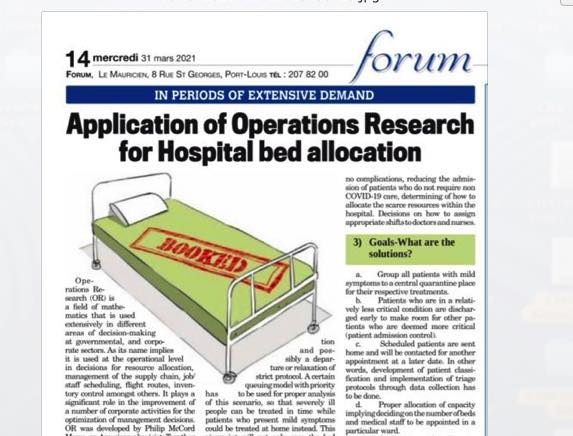
Rapid information-driven decision-making and learning
Everything revolves around information. Decisions must be made quickly. It will not matter whether you have high-quality, timely data if the people in charge or healthcare systems are unwilling or unable to act on it swiftly. In a fast-moving crisis, hierarchical systems, which are sluggish in the best of circumstances, are completely ineffective. In a pandemic, great management focuses on giving frontliners the resources they need to fix issues swiftly and learn.
The primary focus should be on learning. Experiments must be learned from, even those that didn’t work out, but this can only happen if an institution’s leadership establishes a psychologically safe and open environment. The healthcare organisations that will combat best against COVID-19 are those that learn quickly, not those that have all the answers.
