

Dans notre rubrique « Penseurs du Sud, N0.9 », nous avons présenté René Noyau (1912-1984) comme un des penseurs de notre pays dans la lutte pour l’indépendance et le combat des peuples pour le droit à l’autodétermination. Lorsque Noyau rentra de Chine, il écrit Le procès Bissoondoyal à la requête de Basdeo Bissoondoyal. Le texte fut publié en 1964 sous le fameux pseudonyme Jean Erenne (nom de plume de René Noyau).
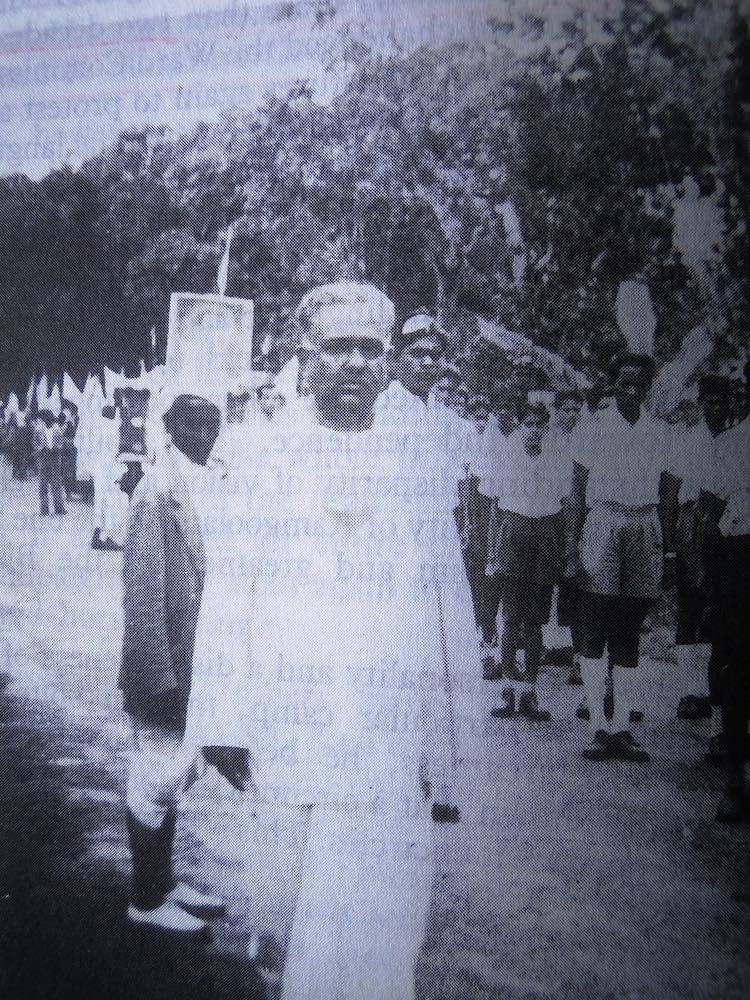
Il raconte le procès de Basdeo Bissoondoyal qui se déroula en 1944. L’auteur dit ceci dans le premier paragraphe de sa publication : « […] pour la première fois dans nos annales coloniales, un religieux a été trainé en cour et condamné à la prison alors qu’il n’avait vraisemblablement fait que ce que d’autres religieux faisaient : prêcher la parole de Dieu. » (René Noyau, L’œuvre, Volume II, 2012). Dans la publication Selected Works of Bissoondoyal, Vol, V (1991), édité par Uttam Bissoondoyal nous retrouvons parmi les écrits de Basdeo un texte fort intéressant avec le titre « Indians in Mauritius : reevaluation » (pp.39-78). Dans ce texte, Basdeo analyse la place des Indiens dans l’histoire de Maurice. Même si Labourdonnais est considéré comme « the greatest of all governors of Mauritius » (p.39), il précise que l’apport des artisans indiens de Pondicherry est indéniable. Aussi, il donne une autre version de la conquête de l’île Maurice par les Anglais (p.43). Il montre comment les soldats indiens, les Sepoys, jouèrent un rôle déterminant dans cette conquête. Finalement, il donne un compte-rendu du passage de Gandhi au pays en 1901 (p.66). Cette réévaluation de l’histoire des Indiens est une tentative audacieuse de Basdeo Bissoondoyal de raconter l’histoire dans la perspective des dominés. C’est de la contre-histoire. C’est la version qui prend à contrepied celle de l’Européen. Cela permet aux dominés de se réapproprier leur histoire. C’est un processus d’ancrage à l’envers. Basdeo Bissoondoyal reprend le récit glorieux du colonisateur et démontre que si les faits sont glorieux, c’est grâce aux dominés. De ce fait, notre penseur du sud introduit l’étrangéité dans l’histoire. Par « l’étrangéité » on veut dire introduire un élément contraire à ce qui existe déjà.
Dans son ouvrage « The Theft of History » (2004) et traduit en français en 2010 (« Le Vol de l’Histoire »), l’anthropologue Jack Goody raconte la mainmise de l’Occident sur l’histoire. Il montre comment dans la manière de conceptualiser et de présenter le passé que l’on part des événements qui se sont produits à l’échelle provinciale de l’Europe – occidentale, le plus souvent – pour les imposer au reste du monde. Le but de Jack Goody n’est pas de réécrire l’histoire du monde, mais celui d’analyser la façon dont celle-ci a été mise en forme par le point de vue européen, dépossédant l’Asie et l’Afrique, notamment, d’une partie de leur histoire. Ce fut le cas de Basdeo Bissoondoyal quand il entreprit de parler de la place des Indiens dans le pays. Il reprit « l’histoire volée » et la restitua au peuple. Pour ce dixième numéro, j’ai sollicité la collaboration de mon collègue historien Satyendra Peerthum pour nous parler de Basdeo Bissoondoyal, qui est né le 15 avril 1906 à Tyack. Dans cette première partie, nous verrons la figure historique de Basdeo Bissoondoyal, l’homme du peuple et la recherche d’un missionnaire chez le peuple.

…
The Historical Figure
In 1991, the late Uttam Bissoondoyal, former Director of the Mahatma Gandhi Institute and Basdeo’s nephew, captured the essence of his uncle’s long struggle in Mauritius, when he wrote in his preface to the fifth volume of Selected Works of Basdeo Bissoondoyal (1991) : “Basdeo’s life has integrated the intellectual and spiritual life and the political, social, and cultural uplift of the Indian community. Without him, future historians will no doubt say, our history would not have been the same. Although he became the exponent of the Indianism of Gandhi, Tagore, and Dayanand and propagated a new vision of the intellectual and spiritual India”. Indeed, today historians unanimously agree that, as a defender and leader of the oppressed people of our country, Pandit Basdeo Bissoondoyal followed in the footsteps of such illustrious Mauritian historical figures as Reverend Jean Lebrun, Rémy Ollier, Napoleon Savy, Adolphe de Plévitz, Manilal Doctor, Pandit Cashinath Kistoe, Dr. Maurice Curé and Emmanuel Anquetil.
The Man of the People
Between 1939 and 1991, Professor Bissoondoyal was a leader and a key figure in the Indo-Mauritian community and of the local Arya Samaj movement. He greatly influenced and molded three generations of Indo-Mauritians through his estimated 6000 fiery public sermons attracting crowds of people varying from 5000 to 30,000. For a period spanning more than five decades, he dedicated his life to reviving and firmly entrenching Hindu traditions, customs, and values into the lives of Indo-Mauritians throughout the island.
Ever since December 1939, Bissoondoyal used public sermons, bhaitkas, and the organization of mass Hindu festivals to preach and educate the Mauritian masses. In his brilliant biography of Pandit Bissoondoyal, Abhimanyu Unnuth, a well-known Mauritian writer, eloquently explained: “The missionary, Basdeo Bissoondoyal, answered the call of the moment: he toured every village and every town. Through his sermons, his books and the influence he exerted on the people, he imparted to them the strength needed to stem the strong current which was forcibly carrying them away. This was nothing less than the process of a powerful revolution which in years to come was to constitute the foundation of a significant cultural and political movement”.
The Genesis of the Missionary’s Mission
In 1953, in an article devoted to the anniversary of the Jan Andolan, Sookdeo Bissoondoyal reckoned 1933 as the beginning of the mission of Pandit Basdeo Bissoondoyal. It was not for the simple reason that it was in that year the Mauritian student was admitted to the Dayanand Anglo-Vedic College/D.A.V./, but because he had already started serving his country.
Basdeo Bissoondoyal was reading for his M.A degree at Calcutta University when the Mauritius Labour Party entrusted him to lay before the Indian National Congress the lot of workers in his island home. One can say without exaggeration that the Mauritian delegate did a fine job; he was successful in sensitizing Indian public opinion to the plight of Mauritian toilers under an arbitrary colonial administration.
In order to gauge the magnitude of the task awaiting him at home, one has to have an idea of the situation obtaining in Mauritius on the eve of the outbreak of the Second World War. In her book, ‘Modern Mauritius’: The Politics of Decolonisation’, the American author, Adele Smith Simmons rightly notes the absence of traditional leadership among the Indo-Mauritian masses. The same sentiment was echoed by Sookdeo Bissoondoyal, a school teacher at the time in a letter he wrote to Dr. Curé who had been taken to court by an Indo-Mauritian editor for failing to pay for the printing of a pamphlet. He wrote : “Je vous assure que les pensées injustes et ingrates de cette classe assoiffée de l’amitié des riches et du gouvernement ne trouvent pas d’écho dans les cœurs des pauvres indiens qui associent votre doux nom au grand Manilal. Si ces pauvres sont muets, c’est qu’il n’y a pas d’organisation adéquate pour les amener à livrer au public le secret qui repose dans leur for intérieur.”
The graduate who came back home in December 1939 had brought in his luggage not only a degree in English from Calcutta University, although it would have been no mean prize for somebody who never had the luck to go to a secondary school. He had come with the perennial message of Ancient India. Like the French sanscritist before him, Louis Jacolliot, he had received the message of the Vedas from the Brahmins of Lahore. He was more lucky than the author of The Bible in India. He has the good fortune to receive the message of the Arya Samaj from the hands of Mahatma Hansraj himself at the D.A.V. College. He had come with the message of Sarvepali Radhakrishnan. But he very quickly understood that Mauritius needed at that juncture neither a professor nor a politician but a missionary.
Satyendra Peerthum
REFERENCES
Uttam Bissoondoyal, Promises to Keep (EOI-Wiley Eastern Ltd, New Delhi, 1990)
Uttam Bissoondoyal, Selected Works of Basdeo Bissoondoyal: Volume 5 (MGI Press, Moka, 1991)