

What motivated you to design Rubrix-A?
A lot has been written over the years about the problems confronting the Mauritian education system. There is a sudden flare of commentaries from all quarters when examination results are published, especially when the trend is negative. The most recent one followed the publication of the SC results. Many deplored the deterioration in the results. My aim was not to undertake another postmortem exercise but to propose one small, concrete solution that would effectively address one dimension of student performance at secondary levels – their essay-writing skills.
How does it help the teacher?
It has been observed that, while many primary school teachers assign one essay on average per week, this is often not the case at the secondary level, though exceptions do exist. The main reason is that while a primary school teacher would have 30 essays to mark per week, her secondary counterpart would have about 150 to correct in the same period.
What is Rubrix-A?
Rubrix-A is an AI-powered tool that enables English language teachers to assign one essay per week without increasing their workload. Students may be asked to do all their research at home, prepare the outline, and then write their essay in class after a few minutes of discussion and idea-sharing. Once the essay is written, the students simply have to scan the handwritten pages using their phone and a free ‘Scan to PDF’ app, and upload the essay. In about one minute, the essay is marked, and the student receives a personalised, detailed two-page feedback report. It is primarily a teaching tool. (In the case of schools that have implemented a ‘No-mobile Policy’, students may scan and grade their essays at home later in the evening.) On a side note, because essays are written in class based on ‘research’ done at home, Rubrix-A also indirectly helps reduce plagiarism.
What does the feedback report look like?
The report not only states the marks based on the relevant Cambridge syllabus criteria but, more importantly, highlights the strengths and areas for improvement. At O-Level, it lists key spelling, grammatical, and vocabulary mistakes, offers a list of new vocabulary items with explanations, and suggests content and stylistic improvements. It clearly advises the student on what to do to reach the next level. At AS-Level, the report comments on the quality of the arguments used and the depth of critical thinking, suggests additional arguments, and, if the score is below 50%, even provides exercises to help the student improve the essay’s quality. The sample reports accessible on the login page give a clear idea of the feedback quality and depth.
It is humanly impossible for any teacher to give such detailed, personalised feedback to every student. And yet, this is what students need to improve. Rubrix-A not only enhances the amount of writing practice that students get in class, but also significantly improves the quality of the feedback they receive almost instantly.
How does one access Rubrix-A? Does the teacher or the student require any special equipment?
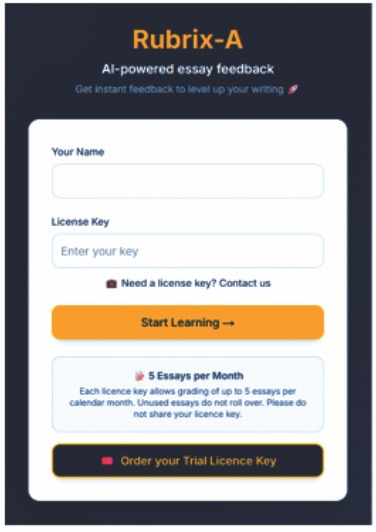
Rubrix-A does not require any special equipment or skills. It can be accessed on a mobile phone or a laptop/PC connected to the internet. It is an app with two pages: the login page and the grading dashboard. Users simply type https://rubrix-a.com on their browser to access the platform
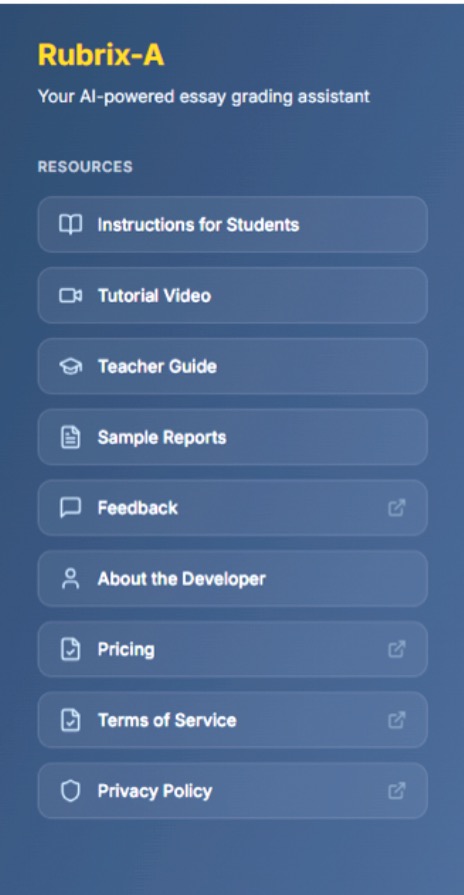
The sidebar on the login page provides all the necessary information for operating the platform. It includes a tutorial video and sample reports, as well as a Privacy Policy that clearly states that essays and grading details are deleted shortly after the user downloads the feedback report. In other words, the platform does not store any of the data submitted by the user.
How would teachers or students know whether Rubrix-A actually delivers on its promises?
Users may request free trial licence keys by clicking the button at the bottom of the login page. Teachers may request free licence keys for a whole class. Each user will be given free access to the platform until February 28, 2026, grade up to five essays, and thus evaluate the platform for themselves.
The students first scan their handwritten essays using the phone camera and a free ‘Scan to PDF’ app. The licence key grants access to the dashboard, where they select the grading level (O-Level/AS-Level) and then enter the essay title or question. This is used by Rubrix-A to assess the relevance of the essay content. They then upload the scanned essay and grade it. In about one minute, the marks are displayed, and the feedback report is ready for download.
They may share this report with their teacher, who will monitor their progress and guide them in their improvement journey.
How does Rubrix-A help in improving student performance in essay writing?
The reports cover almost everything students need to consider to improve their performance. If this cycle is repeated on a weekly basis, there is every reason to believe that students’ performance in essay writing will significantly improve. After all, practice makes perfect! Once writing skills improve, performance in other subjects that also require advanced writing skills will likely improve.
Tell us more about the technical aspects of Rubrix-A. (1)Rubrix-A
Rubrix-A has been designed using paid versions of relevant tools. This contributes to the quality of the reports and ensures that students’ essays are not used to train the LLMs. Rubrix-A’s functionality is likely to improve over time as more powerful LLMs are released.
A critical feature of Rubrix-A is its integration of advanced Optical Character Recognition (OCR) technology. Because Cambridge International Examinations still require handwritten submissions, Rubrix-A allows students to submit scanned handwritten essays. This ensures students maintain the skills required for the exam hall while benefiting from the speed of digital diagnostics.
How will Rubrix-A impact the role of the teacher?
The implementation of Rubrix-A represents a fundamental shift in educational architecture. By delegating technical diagnostics — such as grammar correction, vocabulary enhancement, and scoring — to AI, the educator is unburdened from the “grading chore.” This allows the teacher to focus on mentorship and high-level conceptual guidance, providing the human inspiration that an algorithm cannot replicate.
It is a fact that many students are already ahead of their teachers in using AI. Many are already resorting to AI rather than approaching their teachers when they face difficulties in their studies. The gap between them and their teachers regarding AI utilisation is likely to widen over time. Teachers have no choice but to adapt if they want to remain relevant. Rubrix-A is a humble contribution to this process.
Comment from one English teacher (received by WhatsApp and reproduced with her permission)
Some closing comments …
The platform is already being tested in various schools in Mauritius and Singapore. Some parents have also ordered free-trial keys to help their children at home, while mature students are using Rubrix-A for self-study. It is expected that the use of applications like Rubrix-A will spread in the coming months, significantly enhancing teaching and learning. It is thus in teachers’ interests to embrace selected technological advances to enhance their pedagogy.
Rajendra Patil Hunma
Email : admin@patilhunma.com