JOVIN HURRY
Sustainability Strategist
At the halfway mark of any long wedding, a Mauritian instinct kicks in. It is the moment we stop eating, look around the hall, elbow our neighbour discretely, and quietly ask who has actually been served.
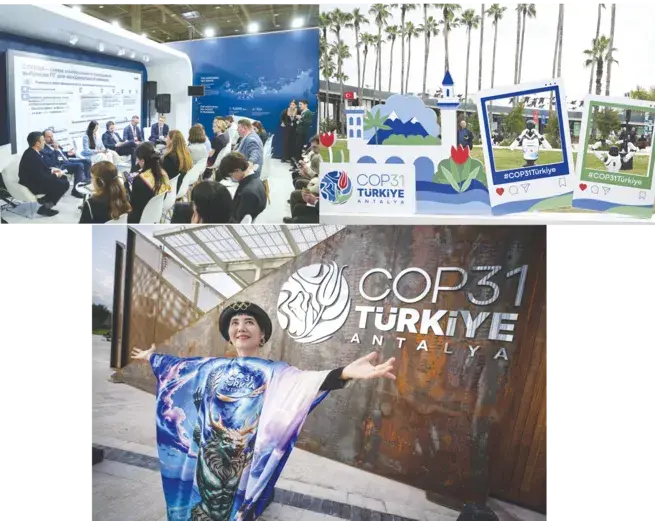
COP31 is the 31st Conference of the Parties to the United Nations Framework Convention on Climate Change and takes place in Antalya, Türkiye, from 9 to 20 November 2026. COP31 has reached that halfway moment.
Last Saturday, UN Climate Change chief Simon Stiell took stock in Antalya. Nearly 200 countries are working through 165 mandates, he said, and « there is no collective success without compromise from every Party » [1]. He urged negotiators to reach the hardest issues quickly and avoid tactical delays [1]. He also praised Telemundo’s Vanessa Hauc for using World Cup hydration breaks to explain the heat [1].
I would only add that the negotiators could use a hydration break of their own, ideally with a referee.
My three tests, at halftime
In my explainer for these pages, « COP 31: Inside the Biggest Climate Meeting » [2], I said I would judge the final text on three things: money for adaptation, money for loss and damage, and a date for coal. Here is my halftime scorecard.
Adaptation: the tripling of adaptation finance is reportedly turning into a bargaining chip, and the adaptation track is stalled [3]. Loss and damage: barely visible in the midpoint material I have seen. Coal: most leaders avoided naming fossil fuels at all [3]. In short: everyone is talking about the electricity, and few want to name the fuel it replaces.
I also predicted that Turkish tea and baklava would become diplomatic currency. I have no audited figures, but the cover decision (this is the political package wrapping up the COP) already resembles baklava: dozens of thin layers, each negotiated separately, held together by syrup, with everyone eyeing the corner piece. It shares baklava’s main hazard, too: it is sweetest before anyone starts cutting it.
However, I found three voices that ask better questions.
Patricia Scotland: a Mauritian hub that punches above its weight
Patricia Scotland, former Commonwealth Secretary General, points to an institution on our doorstep:
« The Commonwealth Climate Finance Access Hub, which is based in Mauritius, is the most creative instrument to deliver real value in climate change finance. With just eight million dollars, we have already delivered, in 2026, five hundred and sixty-six million dollars. It really should be used as a model to ensure that all our Least Developed Countries and Small Island Developing States receive the money they need for adaptation, mitigation and climate change finance. » [4]
Her toolbox: « the debt swaps, the pooled assessment, but also the vulnerability index, and the opportunity to take advantage of the debt clauses in all loan agreements. » [4] Fine print, for once, working in our SIDS and Mauritian favour.
As of now in this COP31 beehive, I cannot confirm the 2026 figure, but the scale is public. A seed of USD 7.8 million had mobilised about USD 322 million by December 2023 [5], and the Commonwealth counts roughly USD 590 million since 2016 [6].
As shared in the previous article, the wording matters. [2] Note the verb here though: « mobilised », not « disbursed ». In 2022 the Hub itself distinguished USD 50 million mobilised from USD 800 million in the pipeline [7]. The pipeline deserves watching, not doubting.
Ebrima Jawara: asking for a hundred, receiving twenty-five
Ebrima Jawara, Permanent Secretary of the Ministry of Environment, Climate Change and Natural Resources of The Gambia, starts with arithmetic every project manager knows:
« With all the projects we had, which were donor-funded, one thing became very clear: the funds were never enough. If you needed $100 million, you might be given $25 million. So you couldn’t really achieve what you wanted to achieve. » [8]
His remedy is to look inward: « We have always had this perception that something coming from outside is better than what we have inside. But that is not necessarily true. » He cites a young man who recycles bottles and tyres and « actually has to buy waste from dumpsites. » [8] Rubbish you say, but waste, it seems, is acquiring a price tag.
On carbon markets he is candid. A carbon trading bill is hoped for early next year, but: « We do not necessarily understand the financial mechanisms, how the transactions are structured, or how the revenues are calculated. And the question is: are we actually receiving a fair share of the revenue? We do not know. » His answer is capacity: « so that we are not cheated. » [8] A draft Gambian bill has been validated by the ministry, and local commentators already argue that communities must be guaranteed a share [9].
Astrid Schomaker: get nature out of the sustainability department
Astrid Schomaker, Executive Secretary of the Convention on Biological Diversity, reports from Yerevan:
« What we find is that we have to stop fiddling around the edges and really move towards transformative change. » Companies must disclose impacts and dependencies, then change practices, but « that is a discussion that cannot simply happen within the sustainability department. It has to move straight into the boardroom, where the big investment decisions are being made. » [10]
On money: « a significant amount of finance, approximately thirty times as much as the finance directed towards positive biodiversity outcomes, is actually directed towards activities that have negative impacts on biodiversity. That is very worrying. » [10] UNEP’s figures are in that range: USD 7.3 trillion harming nature against USD 220 billion for nature-based solutions in 2023 [11].
And on the last mile: « How do we make sure that the money does not stop with the proverbial middleman, if you will, but actually reaches the stewards on the ground? I am talking about Indigenous peoples and local communities, who often know best how to adapt, how to mitigate environmental risks, and how their surroundings are changing. » [10] Middlemen, I note, are the only stakeholders guaranteed to attend every meeting.
What we are not saying
Put these voices beside the summit rhetoric and a gap appears. The summit speaks in headlines: electrification, pledges, compacts. The speakers speak in plumbing: debt clauses, capacity, disclosure, who sits in the boardroom. Nobody gets a photo opportunity for a loan clause, yet that is where a small island’s future is quietly signed.
One question runs through all three: who captures the value? Jawara asks it of carbon revenue, Scotland’s Hub answers it with advisers who help countries win funding, Schomaker asks it of the last mile. The Presidency’s BRIDGE platform aims to make projects investable [12]. The question rarely asked is who benefits once they are. And as my COP31 explainer noted, [2] such Action Agenda items are voluntary: a New Year’s resolution, to be judged in a year.
Now, in our own backyard, Mauritius emits about 0.01% of global emissions, yet NDC 3.0 promises a 40% cut against business-as-usual by 2035, 60% renewables in electricity and an end to coal in power generation, all by 2035 [13].
A 2021 law had set 2030 for coal [14], and a Le Mauricien analysis observed that NDC 3.0 largely repeats NDC 2.0 with a later horizon [15]. We host the institution that teaches others to write bankable proposals, so we should be its star pupil. And if our blue carbon programme [13] ever produces credits, Jawara’s question comes home: will we understand the arithmetic?
Which brings me to Schomaker’s boardroom. In my work building the Mauritius chapter of NELIS Global, a regeneration leadership network, I keep asking whether sustainability sits in the boardroom or in a department two floors down. If the 2035 targets are to be met, it cannot be the latter.
Now into the second final sprint
Stiell wants the hardest issues tackled now [1]. I would add three questions for any negotiator, minister or CEO. Who gets the money? Who understands the contract? Who sits at the table where the decision is made? Let us ask them while the hall is still full and the baklava has not yet been cut.
References
[1] UN Climate Change, remarks by Simon Stiell, 14 Nov 2026.
[2] Le Mauricien, « COP 31: Inside the Biggest Climate Meeting », 30 Oct 2026.
[3] Briefing note, key messages from the COP31 Leaders’ Summit.
[4] Patricia Scotland, recorded interview.
[5] Commonwealth, « Commonwealth Climate Finance Access Hub grows from strength to strength », Dec 2023.
[6] Commonwealth Secretariat, CCFAH submission to the UNFCCC.
[7] Commonwealth Secretariat, Unlocking Climate Finance Access for Small States, 2022.
[8] Ebrima Jawara, recorded discussion.
[9] Gambia Ministry of Environment, draft Carbon Trading Bill; The Standard (Banjul), op-ed. The op-ed published in The Standard (Banjul) is titled « Why The Gambia’s Carbon Credit Bill Must Guarantee a 60% Community Share », written by Ansumana Darboe on June 17, 2025.
[10] Astrid Schomaker, recorded interview, Yerevan.
[11] UNEP, State of Finance for Nature 2026 summary.
[12] COP31 Presidency press release, 14 Nov 2026.
[13] Republic of Mauritius, NDC 3.0, Sept 2025.
[14] Climate Policy Radar, Mauritius, citing Finance (Miscellaneous Provisions) Act 2021.
[15] Le Mauricien, « Mauritius at COP30: Stalled Ambition and Challenge of Delivery ».