

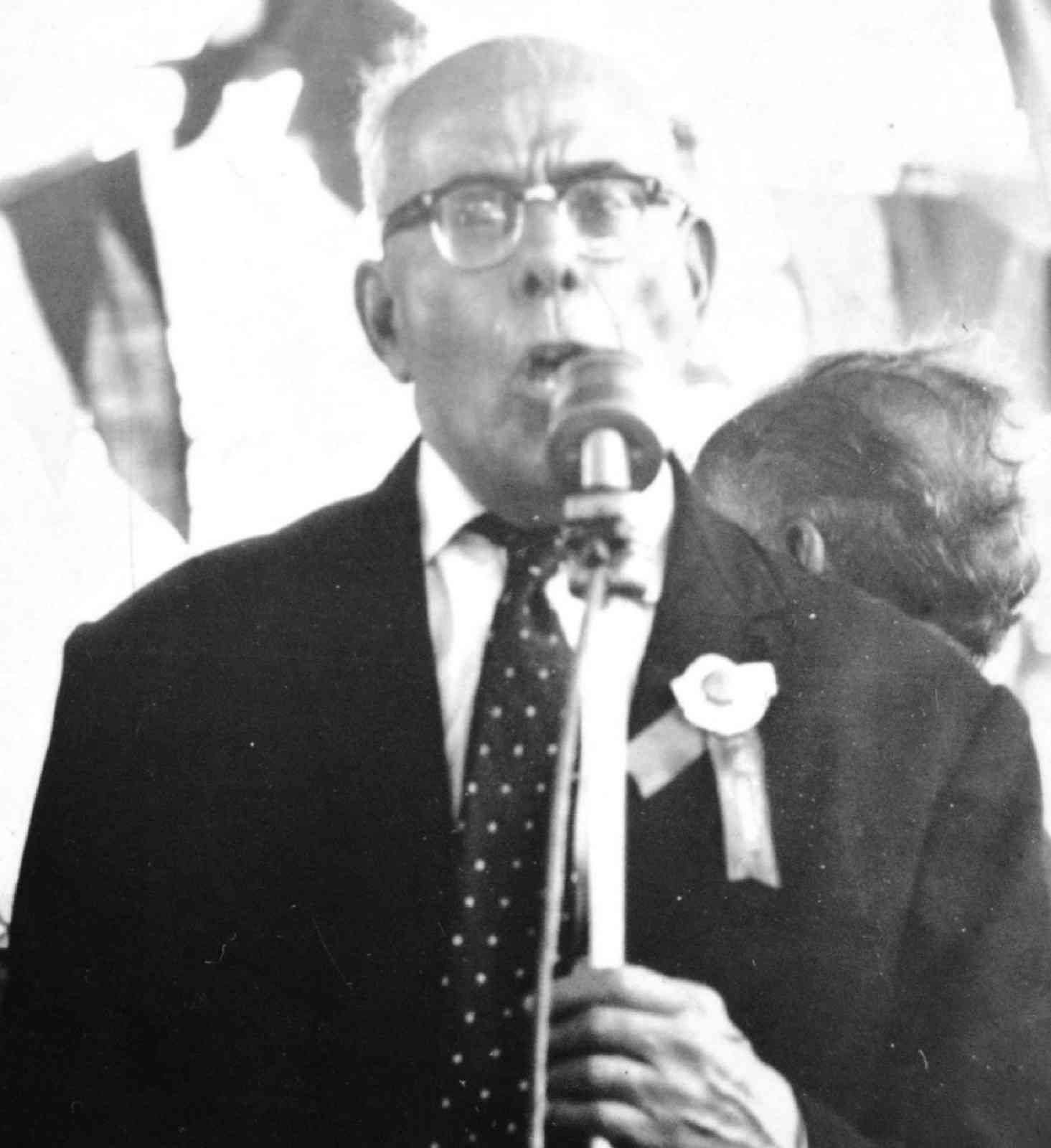
| In 1982, in her landmark book, Modern Mauritius: The Politics of Decolonization, Dr Adele Smith Simmons, an American academic, referred to the period between 1936 and 1968 in Mauritian history as ‘Modern Mauritius’. It was the era of the rise of the Mauritian working class movement and of the island’s decolonization which started with the founding of the Labour Party on 23rd February 1936 which played a central role in the shaping of modern Mauritius. |
This long and complex historical process took place under the leadership of such great labour leaders such as Dr Jules Maurice Curé, Emmanuel Anquetil, Pandit Sahadeo, Guy Rozemont, and Sir Seewoosagur Ramgoolam. However, it was Dr Curé who played a key role in the creation of the Mauritian Labour Party as well as in the genesis of the struggle of the Mauritian workers between 1936 and 1941.
Dr Curé’s Crusade
The struggle for the progress and freedom of the Mauritian workers started in 1934. In mid-January of the same year, some workers organised a peaceful march to Port Louis. For the first time in Mauritian history, the working class put forward their political demands in writing through two petitions to Governor Wilfrid Jackson transmitted by Dr Jules Maurice Curé. The Planters & Commercial Gazette, a pro-ruling class newspaper, called this peaceful protest march of the Mauritian labourers a deplorable agitation. This same colonial newspaper branded Curé a political opportunist who came to politics out of purely humanist feelings.
Between October 1934 and January 1936, Dr Maurice Curé served on the Council of Government. During his brief 15-month mandate on the Council of Government, Curé had transformed himself into an unofficial representative of the island’s working masses after his victory over the ultra-conservative Pierre Hugnin, which was made possible largely through the vote of Indo-Mauritian electors.
During this brief period, he always took up the cause of the Mauritian workers. Unfortunately, in January 1936, in the elections for the Council of Government, Curé was not re-elected. Eight candidates who represented mostly the Franco-Mauritian oligarchy and two candidates who represented the urban middle class were elected. As a result, the Mauritian working class did not have a single elected representative on the Council of Government until 1948.
The First Labour Manifesto
During the weeks following the elections of January 1936, Dr Curé was one of the key figures who promoted the creation of a labour party. On 20th February 1936, in his ‘Manifeste pour un Parti travailliste’ article in Le Mauricien, he explained:
“Seul un Parti travailliste bien organisé, s’appuyant comme il se doit sur le nombre ayant des intérêts communs bien nets, peut s’opposer au parti capitaliste et obtenir de lui le respect de ses droits. Les buts du Parti travailliste…Dans le domaine économique et social, ce but est défini par les statuts du Bureau international du travail de Genève. Dans le champ politique, le parti doit tendre vers sa représentation au Conseil législatif afin de faire adopter et faire respecter les droits que lui confèrent ces statuts. Le Parti travailliste doit militer pour être représenté au Conseil législatif par des nominés, puis si le droit de vote est étendu par l’élection de ses représentants. Quels doivent être ses adhérents? En général tous ceux que l’égoïsme n’aveugle pas, ceux qui ne sont pas insensibles au tableau de la misère engendrée par le chômage, la maladie et les salaires bas. Spécifiquement:
(i) Travailleurs manuels.
(ii) Petits employés du gouvernement.
(iii) Salariés des maisons de commerce et des bureaux.
(iv) Petits commerçants et professionnels.
The labour leader concluded by stating: « J’ai tracé la voie du peuple. Nous sommes le nombre, donc la force… »
The Genesis of the Labour Party
On 23rd February, 1936, the Mauritian working class answered Dr Curé’s call as more than eight thousand workers and some members of the island’s petite bourgeoisie gathered at the Champ de Mars in Port Louis. At this first mass political gathering of the Mauritian working class in the annals of the island’s modern history, the Mauritian Labour Party was born. Dr Adele Smith Simmons accurately explains:
“Unlike previous political groupings, the Labour Party was not controlled by a small clique. Its leaders were a heterogeneous group who believed that the labourers themselves had to organise to force a change.”
On that historic date 90 years ago, Dr Maurice Curé was elected president of this new political party with the unanimous approval of the workers and for the first time in Mauritian history, through direct democracy, a person was chosen as leader of a workers’ party.
Dr Curé’s Character
Jules Maurice Curé, a labour leader, was sincere to his lofty ideals and in his struggle for the Mauritian workers. The most accurate observations on Curé’s character and motivations are provided by Jean Villiers René, one of his mentors and of the three Bissoondoyal brothers. Between the early 1900s and the 1940s, he was a famous teacher and school headmaster in Port Louis. In December 1939, Pandit Basdeo Bissoondoyal carried out an interview of Mr René, which until now has remained unpublished.
In this interview, Mr René explained that the labour leader had:
“Une idée fixe. C’est d’amener l’évolution sociale. Il a voulu accélérer les choses. C’est Curé qui a ouvert mon esprit. On traitait les travailleurs illettrés à la campagne comme on voulait. Dr Curé leur a fait connaître leurs droits. Loin de lui l’idée du sabotage. Ça va sans dire, il est le plus grand homme politique que les autres politiciens du jour.”
In Modern Mauritius, Simmons, who interviewed Dr Curé during the course of her doctoral research in Mauritius in late 1960s, accurately observes:
“Maurice Curé was a very unlikely labour leader. Neither a demagogue nor an opportunist, he was actually a poor public speaker; nor did he enjoyed spending time gossiping with labourers. But he was ready to risk his reputation and his practice by trying to organise labour, a group who until this time had not even protested to the government.”
The First Historic Meetings
How did Dr Curé try to make the Mauritian workers know about their rights? Between February and July 1937, the Labour Party carried out its campaign to mobilise workers by holding around 55 public meetings throughout the colony attended by more than 55,000 workers. According to Gaëtan Raynal, a Mauritian writer, it was only in March 1937, that Jean Baptiste C. Anquetil, or better known as Emmanuel Anquetil, made his first public speech as a member of the Labour Party at Camp de Masque in Moka district.
Colonel Deane, the Chief of Police, noted that Anquetil’s speciality was to whip up the feelings of the crowd. The campaign of the Labour Party under the guidance of Curé, Anquetil and Sahadeo was indeed the first school of mass political education. It was literally the pedagogy of the oppressed almost a generation before Paolo Freire, a Brazilian educated and philosopher, during the 1960s among the working class in rural Brazil. Between 1936 and 1948, the Mauritian working class became a political force even though it neither had the right to vote nor a representative on the Council of Government.
Unfortunately, due to the repression, Dr Curé had no choice but to step down as party president in May 1941. He was replaced by Emmanuel Anquetil with the unanimous approval of the Labour Party at their meeting in the Port Louis Municipal Theatre. For many years, Curé’s important contribution in the making of modern Mauritius was not acknowledged by many historians and writers.
According to late Dr Satteeanund Peerthum, a former Mauritian historian, ex-minister and former ambassador, it was only in 1970, that Dr Jules Maurice Curé and Pandit Sahadeo were given a medal each by the Mauritius Labour Congress in recognition for services rendered to the Mauritian working class as well as in the founding of the Labour Party.
Immediately after, in his speech, Dr Curé declared, with a great deal of emotion:
“Cette médaille, je la remettrai à mon fils, comme le plus précieux héritage qu’il me soit donné de lui laisser. Il la fera transmettre, je le souhaite, à toutes les générations qui me succèderont, comme le symbole d’un attachement vrai à la cause de ceux qui travaillent, de ceux qui peinent, de ceux qui souffrent.”
Ironically, at the age of eighty-four, this was one of the few official recognitions and decorations that Dr Jules Maurice Curé received during his long, fascinating, and eventful life which was dedicated to the creation and establishment of the Mauritian Labour Party. He passed away in 1977 at the age of 90 years.
Satyendra Peerthum
Historian, Writer, & Lecturer

