

Professor SHEILA BUNWAREE
On the sidelines of the G20 Finance and Central Bank Governors Meeting held in Gandhinagar, India from 17 to 18 July 2023, Indian Finance Minister, Nirmala Sitharaman also organised a number of other important events. The latter included a high level tax symposium for “combating evasion, corruption and money laundering…” This could perhaps have been an opportunity for Mauritian Minister of Financial services to obtain the clarification that Mauritius is seeking on its exclusion from the list of jurisdictions which have been exempted from the Angel tax.
Angel tax is levied on the capital raised by unlisted companies (startups) from non resident if the amount raised exceeds the fair market value of the company. This tax was introduced in 2012 to apparently curb money laundering but a number of stakeholders argued that it discouraged investments, particularly in the startup sector. The Central Board of Direct Taxes (CBDT) of India recently released a communique indicating that some 21 countries including the US, the UK, Germany and France have been exempted for investment from the levy of Angel tax.
The Mauritian Minister of Financial Services tells us that he is seeking clarification on the issue. He notes:
“…. so far, we do not understand the rationale around the choice of these 21 countries, but we are seeking clarification from the concerned authorities…”
The Minister also adds : “you will appreciate that Mauritius is among the very few countries in the world to have complied with all 40 FATF recommendations on AML/CFC (anti money laundering/countering financing of terrorism requirements…”
Appreciation of Compliance with FATF recommendations by certain stakeholders is ONE thing but whether the Mauritius jurisdiction is truly clean and free of money laundering is another. Could the fact that Mauritius attracts major investments in the real estate sector and the latter being a Launchpad encouraging criminals to find increasingly creative ways to launder illicit funds have anything to do with India’s decision to exclude Mauritius from the list of exempted countries ? Or is it because Mauritius is known to have a parallel drug economy and that it is number one in drug trafficking in Africa, according to the ENACT organized Crime Index?
Mauritius, being kept outside the ambit of the new rules regarding the Angel Tax could also imply investors turning to other destinations and companies would rather prefer to go directly to India to avoid the Angel tax. In this context, some see The Gujerat International Financial Tec City (GIFT) Centre easily becoming a major competitor to Mauritius and Singapore.
Anil Joshi, managing partner India captures this very well: “Tell me why you would go to Singapore, Mauritius or elsewhere if you can access the same benefits here at the GIFT city IFSC….”
Commenting on the CBDT’s communique and the new rules, Babita Rani, a tax consultant notes:
“The introduction of Angel tax exemption through recent tax laws in India is a significant step towards creating a favourable ecosystem for Startups. The increase in the threshold, simplified compliance, and relief for angel investors provide a much needed boost to the Indian startup ecosystem. These measures encourage entrepreneurship, attract investments and promote innovation, ultimately contributing to economic growth and positioning India as a global hub for startups. The Angel tax exemption is a game changer for startups, unlocking their potential and creating a vibrant landscape for innovation and growth…”
Needless to say that the heavily indebted and vulnerable Mauritian economy risk taking another severe blow with such developments. True, India has signed the Comprehensive Economic Cooperation and Partnership Agreement (CECPA) with Mauritius in 2021. While this may facilitate trade and help both economies to grow, CECPA is seen, by some, more as a strategic move by India in the context of China’s rising dominance in the Indian Ocean rather than benefiting Mauritius in a significant manner.
Can Mauritius leverage its economic diplomacy to obtain the “clarity” that the Minister of Financial Services is seeking? Is it enough to be good friends and/or to be “chota bharat” to defend our interests? When Narendra Modi addressed the Mauritius parliament in March 2015, he spoke of the “powerful links of heart that have endured time and distance in this magnificent land”, going on to state:
“these links form the firmest foundation of our relationship. They have created goodwill and warmth rarely seen in international relations. They have built an unbreakable chain of trust between us….We relate to each other from the comfort of our shared democratic values. We are partners in our economic progress. We shoulder our shared responsibility to advance security in the Indian ocean…yesterday, I told Prime minster Jugnauth that we understand the importance of the offshore banking sector for your economy… In the life of a nation, as in the life of an individual, there is nothing more precious and satisfying than a true friend and well wisher, nothing more comforting than his embrace, nothing more valuable than his trust, nothing more reassuring than his support, nothing more enriching than his partnership… So we are blessed to have your friendship, and I always say that if there is one country that has full claims on us, it is Mauritius…”
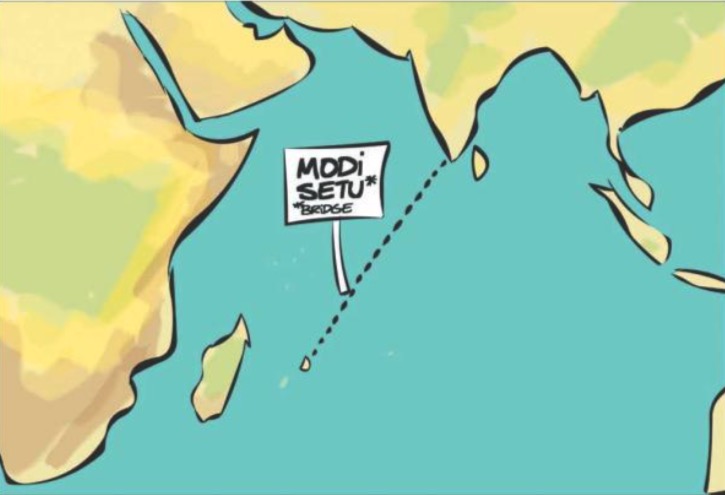
The above is all so beautiful! Can small Mauritius sharpen its diplomatic and foreign policy tools to perhaps make certain “claims” which can help us preserve our interests and benefit the people of the Republic of Mauritius. Is it the Modi kind of friendship which has cost us Agalega? Having met a number of Agalean women during the last few months and hearing their stories, one is left to wonder whether there is another historical tragedy in the making, resonating with that of the Chagossian?
Can the beautiful language of diplomacy expressed by Modi not only in Mauritius but more recently in the US, France, Egypt and UAE be translated into significant interests for all, extending beyond ‘friendships’’ and resulting in win-win scenarios, equitable and inclusive partnerships.
The Indian Foreign minister/career diplomat – Jaishankar’s latest book’ ’The India way’, in which he emphasises the necessity of “breaking free of a past hampered by India’s ‘soft state’, ‘fatalism’’ and “missed chances’’, makes one wonder what possibilities and choices do small, resource-poor states like Mauritius, increasingly bereft of diplomatic acumen, have as emerging nations seek to recalibrate the balance of power? Can Mauritius make ‘’claims”, let alone ‘full claims’’ on India, as per Narendra Modi’s pronouncement in Mauritian parliament, in 2015?
Jaishankar makes it clear that there are no allies or friends, but only ‘frenemies’, in an increasingly multipolar world. In the ‘transactional bazaar” that Jaishankar speaks of, India seeks to advance its national interests by identifying and exploiting opportunities created by global contradictions. From Jaishankar’s perspective, it is time for India “to engage America, manage China, cultivate Europe, reassure Russia, bring Japan into play, draw neighbours in, extend the neighbourhood and expand traditional constituencies of support….”
Given our historical links with India, Mauritius is perhaps more than just a neighbour or a friend. But does our relationship with Modi’s India guarantee our long term security and interests? It is high time that Mauritius hones its diplomatic skills and strategises so that it does not become a beggar in the international arena. Our Sovereignty and Dignity go hand in hand! International relations will become increasingly complex in the new emerging order and it will be incumbent on a new government to ensure that Mauritius develops a pool of career diplomats instead of relying on political nominees and/or ministers who can easily fall prey to certain foreign powers’ agendas rather than preserving the interests of future generations.
…
ACCROCHE
Needless to say that the heavily indebted and vulnerable Mauritian economy risk taking another severe blow with such developments. True, India has signed the Comprehensive Economic Cooperation and Partnership Agreement (CECPA) with Mauritius in 2021. While this may facilitate trade and help both economies to grow, CECPA is seen, by some, more as a strategic move by India in the context of China’s rising dominance in the Indian Ocean rather than benefiting Mauritius in a significant manner.
