

VICTORIA FAUVE DESVAUX DE MARIGNY
Last month – as it’s the case each July since 2011 – took place ‘Plastic Free July’, a global initiative of the Plastic Free Foundation aiming to encourage a ‘world free of plastic waste’. The month-long challenge encourages the reduction of single-use plastic usage by  providing resources and ideas on how to do so. Through daily prompts throughout the month such as ‘bringing your own shopping bag’, ‘choosing reusable water bottles’ or ‘choosing natural fibre fabrics’, the challenge aims to showcase that solutions to the single-use plastic issue are approachable and can be integrated into our daily routine.[1]
The fight against single-use plastics has almost become a symbol of the environmental movement these last few years but is only one part of the bigger issues of waste impacts and natural resource over-extraction. For the sake of simplification: all items that surround us – not only single-use plastics – are made from materials that, in a linear economy at least, we extract from the earth. The issue is that we currently extract way more natural resources than the planet can regenerate in a similar timeframe. To demonstrate this, each year The Global Footprint Network – an international research organization- calculates ‘Earth Overshoot Day’: ‘the date when humanity’s demand for ecological resources and services in a given year exceeds what Earth can regenerate in that year’. This year, Earth Overshoot Day fell on August 2. This basically means that, once again for the sake of simplification, we currently live ‘on credit’ in terms of natural resources for the rest of the year.[2] There’s of course also the end-of-life question, the waste issue: where do our items end up when we ‘throw them away’ after usage, and how do they impact their surrounding environment then? To have an even more accurate picture of an object’s impact, we actually need to look at all the stages of the object’s life –including its usage, production, and transport, not only its sourcing and end-of-life as mentioned above- and how the object impacts its environment throughout all these stages… This cradle-to-grave approach exists mostly in a linear economy, the type of economy in which we primarily live-in nowadays; in a more circular economy, materials are not discarded at their end of life but reused, either as is or to create other items – hence bypassing both waste impacts and natural resources over-extraction issues.
The fight against single-use plastic as a symbol of environmentalism is interesting: while only one part of the bigger issues of waste impacts and natural over-extraction, which are themselves interlinked with many other environmental issues, why does it create so much zeal? Plastic pollution is an incredibly complex issue that might sometimes be oversimplified: indeed we need to remember that what we call ‘plastics’ cover a wide range of materials, each with their own specificities. Plastics are, usually, made from fossil resources and hence come with all the environmental problems that fossil resource extraction comes with. When they leak into the environment, when not correctly disposed of, they can pose threats to biodiversity and the biosphere. When we want to recycle them, the numerous different types of plastics that exist and the additives that are added to the base polymers make their sorting and recycling a whole science. The bio-based and biodegradable alternatives are still a topic of hot debate and require specific infrastructures for them to be implemented correctly [such as industrial composters for the biodegradable alternatives]. Finally, plastics also do have properties that make them useful and which enabled massive progress in many areas of human lives – let’s just think about health services and how plastics usages have enabled lives-saving innovations. In brief, it’s a very complex topic with many ramifications and no black-or-white answers – yet, the zeal that debates around this topic can create somehow seems to show that people still want to be involved and ‘do their parts’, despite the complexity.
Per Espen Stoknes, psychologist and economist, has identified five reasons why people might not take action when it comes to climate issues, and I posit that we could extend it to environmental issues at large: Doom, Distance, Dissonance, Denial and iDentity. [3] Plastic pollution, contrary to many other environmental issues that we can’t easily see and which hence feel like distant threats not linked to our personal life, can be seen in our everyday life. It’s something that we experience and that feels part of our personal reality. It’s also something we can feel that we have agency over, something that we can act upon pretty easily – which might help with the cognitive dissonance that environmental issues can otherwise bring up when we know the facts yet do not know how to act upon.
‘The norm’
Some might be skeptics here, wondering how shifting from a plastic bottle to a reusable one could help with the enormity of the environmental issues we face. Going back to Plastic Free July, the initiative actually often goes beyond personal changes: while starting with personal changes, the initiative also shares pieces of advice on how to bring these changes forward to one’s workplace, one’s community, one’s local businesses, and one’s local government. Indeed, by changing our personal habits, we can also encourage those around us. It’s how we go beyond the ‘iDentity’ barrier mentioned by Per Espen Stoknes: if those around us start to normalize and adopt pro-environmental behaviors, if these behaviors become ‘the norm’, we’ll tend to be less reluctant to adopt these behaviors as well. By changing our personal habits, it can also shift our purchase patterns which can influence our local businesses as they adapt to answer the market’s demands. Finally, by changing our personal habits, we might be motivated to go further and ask for legislative changes, which in return help more people and businesses adopt pro-environmental behaviors. I personally believe that it’s not a question of either/or, but that all these solutions can, and must, exist together.
Despite it all, shifting toward more pro-environmental behaviors might still seem like a daunting task, even more when we see how complex environmental questions are. Additionally, we might feel that it’s all doomed and resort to denial in the face of it all – the last barriers to climate actions mentioned by Per Espen Stoknes. Why care or act if this is the case? In her book ‘The climate optimist handbook’, Anne Therese Gennari shares how becoming a ‘climate optimist’ is mostly about a mindset shift; where we get excited about the future and what it can hold. [4] The current environmental situation pushes us toward changes – be it willingly or not. What if, by acting now, we could go toward a future that is even better than the present we have? What if, instead of seeing pro-environmental behaviors as hindrances and linking them to things we have to give up, we explore them as new pathways that can be just as joyous as the habits we’re leaving behind? Such a future might be hard to envision right now but humans throughout history have pushed beyond the limits of what was easy to imagine: airplanes and space-shuttles were also once thought of as impossible. What if, here too, we pushed beyond what we think is possible and imagine – then act toward – a future that is environmentally and socially conscious? What if we, at least, just allowed ourselves to be curious about how this future could look like in our life, community, business, and country? And then, what if we took small actions toward that future? In her book, Anne Therese Gennari summarized it all by sharing that maybe ‘we have to stop worrying about what could be if we don’t act and start getting excited about what could be if we do’.
To go back to single-use plastic pollution, while we should recognize the complexity of the issue and that it’s only one part of much bigger issues; isn’t it amazing that people are feeling strongly enough about this topic to wish to take action? When it comes to the environmental crisis, everyone’s help is welcomed and no starting action too small.
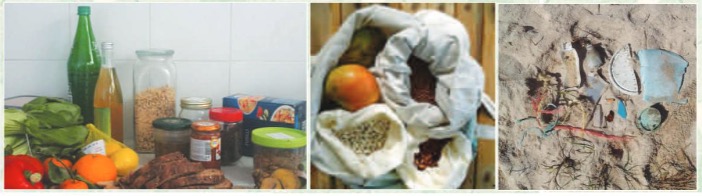
If you’re new to this topic and want to ‘do your part’ as well: start where you are and find what shifts make sense for your life and situation. Invest in a reusable water bottle, and a water filter if needed in your area. Shop for vegetables and fruits without packaging by bringing your own bags. Keep a reusable coffee cup in your car if you go for daily coffee breaks. Learn more about the issue. Support local businesses that repair, upcycle or recycle items. Start recycling what you can’t reduce or avoid. Just start where you are and with what makes sense in your situation – and grow from there. Mostly, why not get curious and dream about the future and all the amazing possibilities we can create all together? And then why not go and do exactly that?
…
(1) https://www.plasticfreejuly.org/
(2) https://www.overshootday.org/
(3) https://www.ted.com/talks/per_espen_stoknes_how_to_transform_apocalypse_fatigue_into_action_on_global_warming
(4) https://www.theclimateoptimist.com/book
