

Jeewan Ramlugun FRSA
On 23 April of this year, it was the 459th birthday anniversary of William Shakespeare, also St. George’s Day as it happened to be.
Why does one feel the urge to unabashedly indulge in a bit of bardolatry when it comes to Shakespeare? 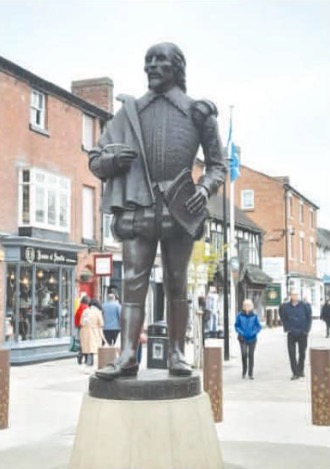
His knowledge was spectacularly encyclopaedic and given his relative short lifespan of 52 years, his literary output was incredibly prodigious, his works unsurpassed in popularity and appeal.
‘Lawyers claim he was a lawyer, doctors think he was medically trained, actors assume he was a thespian, soldiers, sailors and astronomers all claim a kindred spirit, so it is no surprise that knowledgeable gardeners think the Bard’s extensive knowledge of botanical references would qualify him as a Master Gardener’ (Quealy, G – 2017). Botanical Shakespeare: An Illustrated Compendium. New York. Harper Collins. Page 11).
As a playwright and writer of many genres, he is a nonpareil, his ideas and thinking continuing to remain rivetingly relevant to this day and for all time. And, his fervent biographers have tended toward the hagiographic in their depiction of him.
Yet, others are critical of the undue adulation that Shakespeare is accorded, objecting to the cult of bardolatry, and decrying the human propensity for fawning deference to important figures (for example: James Bingall writing in The Guardian, 20 May 2016). 
Nevertheless, the admiring world converges upon Stratford-upon- Avon, to celebrate his birth, to sing his praises and laud his achievements and commemorate his lasting legacies, lavishly waxing lyrical over his genius.
Hence to pay my own homage to this literacy icon, and renew my very many memories of Stratford-upon-Avon, I drove there in the company of my wife after some years. We left behind a rainy West London and upon reaching Oxfordshire, the sun shone, delightfully lighting up the gently rolling verdant plains and pastures, where sheep grazed peaceably, and kite birds circled the air. The River Cherwell and Waterperry Gardens are familiar and memorable landmarks along the way.
Nearing Stratford centre, the areas seemed much more built up than when last visited, the old and new buildings incongruously commingling. But, Shakespeare’s heart of Stratford remains much the same. Charming Tudor-style houses, with half-timber wooden frames, of brick, plaster, wattle and daub made, are dotted around, Shakespeare’s birthplace habitation having similar features.
The streets were lined high up in the middle with colourful flags of many nations, the image of Shakespeare at the very end, unmistakably distinct, all to signal the internationalism of the occasion, and in recognition of the vast numbers of visitors from all corners of the world.
The customary pomp and pageantry marked this special celebration. A Shakespeare Service was held in Holy Trinity Church, including Shakespeare’s Sermon, with performances of some of his verses to music. Also, an official Shakespeare birthday luncheon took place in the theatre gardens.
Some interesting enterprising facets of local commercialism in the name of Shakespeare catch the eye, such as a shoe shop called ‘Much a Shoe About Nothing’, and a ‘Shakespeare Distillery’ corner retailer, where I purchased a Macbeth bottle of beer as a souvenir! So I was there not just in spirit!
The Royal Shakespeare Company situated in Stratford, performs Shakespeare’s plays and the works of his contemporaries, and other later writers.
The RSC boasts one of the most significant collections of Shakespeare’s works in the world.
Shakespeare’s writings encompass a bewilderingly broad array of themes and ideas that have continued to resonate and ring true down the ages. Ecological concerns preoccupied him. In Macbeth, there are references to the imperative of protecting heathlands for nature’s creatures. He also alluded to the cruelty involved in fur trade in Winter’s Tale. In sum, he was unsparing in airing his views on critical environmental matters, inveighing against humans for mismanaging and abusing nature. He questioned human arrogance and folly for presuming superiority over non-human species.
He also evinced a profound fellow feeling for the disenfranchised and the disempowered members of society, as reflected in parts of his works (The Conversation, 21 April 2023). At the same time he also had the support of royal patronage, and mingled with powerful, influential people.
Only a third of the entire corpus of his writings had been in print during his lifetime. The very rare first Folio of Shakespeare’s complete works of 950 pages got compiled seven years after his death, 12 copies going on public display across the country (The Guardian, 23 April 2023).
At the end of the day’s visit it started to rain, but all ended well as we made made our way back.
A plea
Dear Bard of Avon
you have set
the ultimate poetic paces.
It is all beyond us
to compete and complete
the course
as we pant after a metre.
We achieve in comparison
but a small measure
and feel it is quite a feat.
So dear Shakespeare
for those who aim to emulate
you but mostly fail,
do make some allowances.
Neither in subject matter,
nor in sheer lexical mastery,
can we ever be your equal,
but permit us to modestly
make some contributions
to the Muse’s collections.
©Jeewan Ramlugun
Whoever is there now?
Whoever is there now to compare
one to a summer’s day,
the darling buds of May
freshly coming to the fore?
whoever is there
to render the theatre of life
vibrantly real,
in a place mundane, a brief
moment to make supremely surreal?
whoever is there
to bring the immortal lines
of the Bard of Avon
ever closer, with thoughts
and feelings rendered divine?
who is there
to raise the spirit
with recitations perfectly resonant
with sounds to enchant and endear?
(Dedicated to Sheila Lee Robbins, former Shakespearean actress
and playwright, a very close friend)
©Jeewan Ramlugun
