

MITHYL BANYMANDHUB
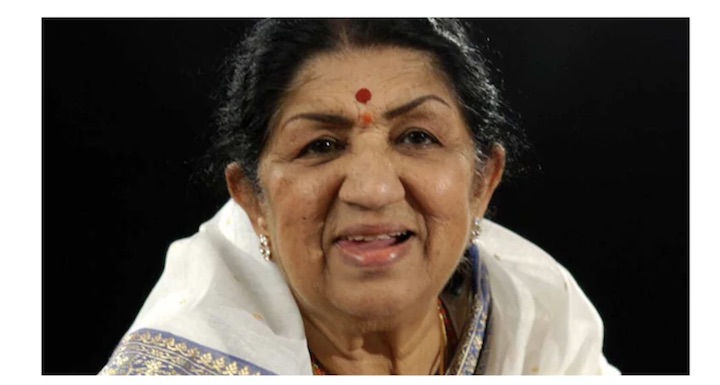
Lata Mangeshkar, whose mellifluous voice and versatility earned her the appellation “the Nightingale of India”, breathed her last on Sunday 6th at Breach Candy Hospital. Her demise marks the end of an era when, as the cognoscenti say, melody wan queen. She is remembered for the multitude of songs she rendered for composers ranging from Khemchand Prakash to Uttam Singh. Over the years she has touched the hearts of people belonging to different generations and tastes. No one could afford to remain indifferent to her.
Going back in time, I can clearly recall the exact moment when I noticed that particular timbre which is considered as a hallmark of Lataji’s genius. Hers was definitely a voice with a difference. I acknowledge that lots of her songs had appealed to my sensibility earlier but when I heard the first notes of Rahein Naa Rahein Hum picturised on Suchitra Sen who acts opposite Dharmendra in Mamta (1966) is something I have never been able to forget despite the passage of more than half a century.
I started to gather information which was readily available about her. Those were the days when publications like Filmfare, Picturepost and Screen provided interesting news about what was happening in the Indian film industry. Once I had discovered her, Lataji continued to captivate me till she put an end to her career.
Birth Of a Celebrity
The person who was destined to become a celebrity and a legend in the course of her life uttered her first cries to the world on September 28th 1929, in Indore (Madhya Pradesh). Little did the people in her surrounding know that she would one day be hailed as “one of the greatest singers India has ever produced.” The Mangeshkar family could be called the premier musical family of India as Pandit Dinanath and his five children Lata, Usha, Asha Bhosle , Meena Khadilkar and Hridaynath have all contributed immensely to the field of popular music as singers and composers.
Recording Of Her First Song
Following her father’s untimely demise, Lata joined the film industry as her family’s sole breadwinner. Thus, in the early part of her career, she was cast in bit roles in some Marathi and Hindi movies. She recorded her first song “Naachu Yaa Gade Kheloo Saree” for the Marathi film Kiti Hasaal (1942). She made her playback singing debut for Hindi films with the song ‘ Paa Laagoo Kar Joree Re’ which was recorded for Aap Ki Seva Mein.
As a singer, the main corpus of her work comprises film songs. The simplicity and easy accessibility of this medium coupled with Lata’s matchless virtuosity cum versatility have made her a natural cultural icon whose songs have stood the test of time. The class, creativity, critical acclaim and cultural impact, side by side with the consistent commercial success of her songs, have set her apart from her contemporaries and have given her the status of “Melody Queen Of India.”
Milestones in Indian Cinema
Most of the stalwarts of Indian classical music have praised her role in popularising their genre among the masses via her semi-classical film songs.
However, it was with the haunting rendition of “Aayegaa Aanewaalaa” for the film Mahal (1949) that she made her mark. After that, her songs have occupied pride of place in the music of almost, if not all, top composers of Hindi film music. These songs have been associated with many important milestones in Indian cinema. Mother India, Anarkali, Barsaat, Nagin, Madhumati and Mughal-E-Azam are the best examples one can offer of what has been termed as the early ‘Golden Era’ of the 1950s and 60s. Bobby, Pakeezah, Ek Duuje Ke Liye, Ram Teri Ganga Maili, Maine Pyar Kiya, Aaapke Hain Kaun, Dilwale Dulhaniya Le Jaayenge and Dil To Pagal Hai, to mention but a few, contain songs which made an impact on the people of the 70s, 80s and 90s. She also sang for the post-millenium era blockbusters like Lagaan and Veer Zara.
Her sentimental rendition of the patriotic song “Aye Mere Watan Ke Logon”, after the Indo-china War, in the early sixties moved the late Prime Minister Jawaharlal Nehru to tears. Lata Mangeshkar also has to her credit many albums like “Lata sings Ghalib”, “Ganpati Aarati” and “Koli Geete” which are not meant for films.
She composed songs for a few Marathi movies in the 1950s and 60s mainly under the pseudonym Anandghan. As a composer, according to her biographer, Dr. Mandar V.Bichu, in Lata – Voice of the Golden Era, “her flair for melody and the ability to smoothly blend classical and folk music are apparent.” She was awarded the Maharastra State Award as Best Composer for the film Saadhi Maanse (1965).
The song,’Aayegaa, aayegaa,aayegaa/ Aayegaa aanewaalaa aayegaa,aayegaa,aayegaa, Aayegaa, is considered as an unforgettable audio-visual odyssey. A moment comes during the song when again in the words of “Dr.Mandar V.Bichu,” Tabla converges with double bass to provide the rhythm and the mystical voice reappears with the refrain of “Aayegaa aanewaalaa, aayegaa,aayegaa”. Every “Aayegaa” carries with it a different inflection, a different appeal. Every note is enchanting, every nuance is picture perfect. It is unbelievable singing! Magical notes delivered with arrow-like precision”!
The song composed by Khemchand Prakash leaves listeners mesmerized in its wake. The melody is striking and the orchestration superb. Above all, the voice is so mysterious, so moving, so musical and so magical that it is simply unforgettable.
As per the prevailing custom, the gramophone record did not mention the playback singer’s name on its label. Thousands of listeners were eager to know her identity. Finally, the radio station director had to find out her name and it was announced that the singer was Lata Mangeshkar. From then on, that name and family name were to become an integral part of Indian music, Indian movies and the Indian psyche.
Range and Potential of Her Voice
It is not surprising that every major composer of the ‘Golden Era’ be it S.D.Burman, Madan Mohan, Naushad Ali, Jaikishan, Khayyam and Salil Chowdhury was later to trace their fascination with Lata’s voice to this song. It is also the song that made composers really conscious of the tremendous range and potential of her voice.
What follow till the time she left her mortal coil is history. Naushad Ali’s thoughts about Lata’s voice clearly come through this poetic tribute originally written in Urdu to her,
Your songs are heard on streets
Your voice echoes through concerts,
Everyone in this world has nothing but praise for you Lata,
The fascination for your art in people’s minds is well understandable
But isn’t it amazing than even God keeps listening to your voice?
She came on earth to express our innermost feelings in an inimitable way. The rest is silence.
Source: Bichu, V.Mandar : Lata – voice of the Golden Era, Mumbai, Popular Prakashan(2010).

