
The measure of a mature democracy is not how faithfully it imitates inherited constitutional traditions, but how courageously it re-examines them in the light of its own people’s aspirations.
The dismissal of Junior Minister Sydney Pierre following his vote against the Government’s pension reform should not be remembered merely as another episode of party discipline.
It should be remembered as the moment that invited Mauritius to ask one of the most important constitutional questions since becoming a Republic: Has our democracy outgrown the constitutional vocabulary through which we continue to describe it?
Public debate has understandably focused on Sydney Pierre himself. Some defended his dismissal by invoking the familiar language of the Westminster tradition: Cabinet solidarity, collective responsibility and party discipline. Others defended his liberty of conscience, noting that he was a Junior Minister rather than a Cabinet Minister and questioning whether those conventions automatically applied to him.

These are important questions. Yet they are not the most important ones. The Sydney Pierre episode is merely the mirror. What it reflects is a much deeper constitutional reality.
For generations, Mauritians have been told that ours is a Westminster democracy. Whenever constitutional controversy arises, the answer seems almost automatic:
“That is how Westminster works.”
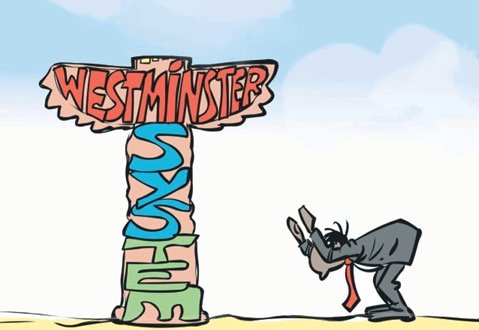
But is it? Or have we gradually transformed “Westminster” from a constitutional tradition into a political doctrine that discourages democratic reflection?
Mauritius is not the United Kingdom. We are a sovereign Republic governed by a supreme written Constitution. Our constitutional order is founded upon constitutional supremacy, judicial review and republican institutions.
Britain’s constitutional order evolved over centuries through parliamentary sovereignty, conventions and gradual political practice. Our constitutional reality is different.
Yet, paradoxically, we continue to justify many of our political practices by invoking conventions developed for a constitutional monarchy with entirely different constitutional foundations. This should concern every democrat, regardless of political affiliation.
The question is therefore not whether Westminster is good or bad. The question is whether Mauritius has reached the constitutional maturity to recognise that what we claim as Westminster parliamentary system has undergone alteration which has distorted its proper political functionality. Do the distorted remains of inherited conventions continue to serve the democratic aspirations of the Mauritian people?
The Sydney Pierre “prise de position” illustrates this dilemma perfectly. Here was an elected representative who publicly disagreed with Government controversial policy and ultimately voted according to his convictions. Whether one agrees with his vote is almost beside the point.
The real question is this: To whom does an elected representative owe his first loyalty? To the Prime Minister? To the Cabinet? To the political party? Or to the citizens whose votes mandate him democratic legitimacy?
Representative democracy was never intended to reduce Members of Parliament to extensions of the executive. Their legitimacy comes first from the people. That question becomes even more significant when a Government introduces policies that many citizens perceive as departing from the commitments upon which it sought and obtained electoral support.
Party discipline has always been justified as the mechanism through which a government implements the programme endorsed by the electorate. But if the Government itself substantially departs from that discours programme and electoral manifesto, does the democratic justification for demanding absolute discipline remain equally compelling?
Or does the representative’s duty towards the electorate become stronger? These questions are not attacks upon democracy. They are expressions of democratic maturity. Indeed, they reveal a broader problem that extends well beyond one parliamentary vote. The Westminster model was never intended to be a rigid constitutional orthodoxy.
Westminster itself has constantly evolved. Countries inspired by that tradition have shown remarkable constitutional imagination. New Zealand modernised parliamentary scrutiny by strengthening select committees and public participation in legislation. South Africa, after apartheid, deliberately created a constitutional democracy in which Parliament is required to legislate consistently with constitutional values, public participation and judicial accountability.
The Scottish Parliament was consciously designed to avoid excessive executive dominance by empowering committees and encouraging a more deliberative parliamentary culture.
These democracies teach us an important lesson. They did not abandon Westminster.
They adapted it. They recognised that constitutional traditions are living instruments, not sacred relics. Mauritius, however, often behaves as though inherited conventions cannot be questioned. Even our Standing Orders increasingly appear to favour procedural discipline over democratic deliberation.
Too often they facilitate executive control rather than parliamentary independence. Too often they regulate debate rather than encourage it. Too often they remind Members what they cannot do instead of empowering them to fulfil their representative mandate.
This is not a criticism of parliamentary order. Rules are indispensable to democracy. But rules exist to serve democratic deliberation—not to replace it. A Parliament that cannot freely deliberate gradually ceases to deliberate.
It simply ratifies.
No constitutional model should become a constitutional dogma. Every constitutional tradition must periodically answer one fundamental question: Does it still strengthen the sovereignty of the people?
If party discipline consistently outweighs representative conscience… If executive authority increasingly overshadows parliamentary scrutiny… If Standing Orders become instruments of conformity rather than deliberation…
Then constitutional reflection is not only legitimate. It becomes necessary. Mauritius has now reached that moment. Perhaps what our Republic now needs is not another constitutional amendment. Perhaps it needs a Second Constitutional Conversation.
The first constitutional conversation gave us Independence. The Republic was without consultation with the people of Mauritius. The next constitutional conversation should ask an even more profound question:
How should a twenty-first century Mauritian Republic govern itself?
Should we abandon Westminster? Should we copy it uncritically? Or should we develop a parliamentary philosophy rooted in our own democratic experience? Such a conversation should begin with practical reforms.
Our Standing Orders deserve comprehensive review to ensure they encourage genuine deliberation rather than excessive rigidity.
Parliamentary Committees should become genuine centres of democratic scrutiny, with wider investigative powers, compulsory public hearings on major Bills and greater opportunities for citizens, universities, civil society organisations and constitutional experts to contribute before legislation is adopted.
Private Members’ Bills should receive meaningful opportunities for debate and decision.
Parliament should also reflect on whether conscience votes ought to be recognised on exceptional questions involving profound ethical issues or significant departures from electoral commitments, thereby preserving the representative’s duty not only to party but also to the electorate.
Finally, Mauritius should establish an independent Constitutional and Parliamentary Reform Commission bringing together constitutional scholars, jurists, former parliamentarians, civil society and citizens to review our parliamentary conventions, Standing Orders and democratic institutions in light of our republican identity and the best practices emerging across modern parliamentary democracies.
None of these proposals would weaken Government. On the contrary, they would strengthen its democratic legitimacy. Governments derive authority from the confidence of Parliament. Parliament derives legitimacy from the confidence of the people.
That democratic chain must never be weakened.
The Sydney Pierre episode may therefore one day be remembered not because a Junior Minister lost his office. But for the outburst of a ’zanfan Cite’ who could feel and know from his deeper self what pension really means for the needy workers after a life of hard work and struggle versus some who were born with a silver spoon. A ‘lalit de klas’ perspective.
But maybe most importantly, it may be remembered because it prompted Mauritius to ask a far more enduring question: Does democracy exist principally to preserve executive discipline, or to preserve the sovereignty of the people through a Parliament capable of genuine thought, genuine debate and, when conscience so requires, principled dissent?
That is not a partisan question. It is a republican question. And perhaps it is the question that will define the next chapter of Mauritian democracy. For republics do not mature by preserving inherited constitutional formulas unchanged. They mature by having the confidence to question them, adapt them and, when necessary, create constitutional ideas worthy of their own history, their own people and their own democratic future.
The time has come to begin Mauritius’ Second Constitutional Conversation.
Danielle Turner