KAMALIKA MISHRA*
From NEW DELHI
Once again, Chhath Festival has arrived, bringing with it a wave of nostalgia, devotion and spiritual warmth. One of the most cherished cultural traditions of Bihar and Jharkhand, Chhath has now transcended geographical boundaries, emerging as a global cultural celebration that brings together communities in a mosaic of faith and diversity. Observed over four days (From 13 to 16 November) during Kartik Shukla Paksha, it culminates in two profoundly moving moments: the evening offering to the setting Sun on Shashthi and the morning offering to the rising Sun on Saptami.
For me, Chhath is more than a religious observance. It evokes my childhood memories in Bihar and Jharkhand and a cherished tradition deeply etched in my heart.
From Festive Memories
to the Banks of the Yamuna
Some childhood memories never fade. They return through a song, a flickering lamp or the aroma of a favourite delicacy. Looking back on those early years in Bihar and Jharkhand, I recall festive days filled with warmth, laughter and family gatherings. Glowing earthen lamps, new clothes, festive delicacies and children’s excitement remain vivid in my memory. From Diwali to Govardhan Puja and Bhai Dooj, known as Bhar-Dutiya in Bihar, each festival brought its own joy. Yet Chhath held a special place in my heart, blending faith, family, nature and community.
As Chhath approached, ponds were cleaned, ghats decorated and bamboo baskets and soops (flat bamboo trays) arranged. Homes bustled with preparations, seasonal fruits, sugarcane and freshly made Thekua – a sweet made with wheat flour, ghee and jaggery. Families and neighbours joined hands to prepare the offerings, observing ritual purity and turning everyday surroundings into a sacred space.
The legendary folk singer Sharda Sinha brought the soul of Chhath into countless homes through her melodious songs. One prayer remains close to my heart: ‘Pahile-pahile hum kaini Chhathi Maiya vrat tohaar…’ (For the very first time, I am observing your sacred fast, O Chhathi Maiya. Please forgive any mistakes or inadvertent lapses on my part.)
In Mithila, northern Bihar, Chhath was followed by Sama-Chakeva, a folk festival celebrating the bond between brothers and sisters, besides Bhai Dooj. I fondly remember the colourful clay figurines, family gatherings and Maithili folk songs that filled the evenings. One song remains etched in my memory: ‘Kaune Bhaiya Ropal Aamun-Jamun, Kaune Bhaiya Ropal Gulaab Ge Maai…‘ (Which brother planted the mango and jamun trees? Who planted the roses, dear mother?)
The glow of Diwali lamps, the fragrance of Thekua and the melodies of Chhath and Sama-Chakeva evoke a childhood rich in colour, affection and belonging.
As the years passed, life took me beyond Bihar, but Chhath remained a cherished link to my roots. The festival travelled with me through memories, songs and traditions. In Delhi, these memories came alive along the banks of the Yamuna. The sight of devotees gathering for evening prayers, familiar Chhath songs and offerings glowing against the setting sun transported me to my childhood celebrations.
What moved me the most was seeing how a festival rooted in Bihar had found a home in Delhi. People from all walks of life came together to prepare the ghats, make offerings and celebrate in shared devotion. I felt that a little of Bihar had travelled with me and found a home once again in the heart of Delhi.
Four Days: One Faith & Endless Devotion
Chhath unfolds over four sacred days, each marked by purity, prayer and devotion. The first day, Nahay-Khay, begins with a ritual bath and a simple meal. On the second day, Kharna, devotees fast until sunset and break their fast with rice kheer cooked with milk and jaggery, along with puri. Thereafter begins the rigorous nirjala vrat, a fast without food or water.
On the third day, fruits and delicacies are arranged in bamboo baskets and soops. During Sandhya Arghya, devotees gather at riverbanks and ponds to offer prayers to the setting Sun, singing devotional songs in chorus. The fast continues throughout the night. Before sunrise on the fourth day, devotees offer Usha Arghya to the rising Sun, bringing the fast to an end. The prasad is then shared with family, neighbours and the community.
Worshipping both the setting and rising Sun gives Chhath its distinctive spiritual character. It expresses gratitude to nature, reverence for the Sun’s life-sustaining energy and faith in the eternal cycle of life and renewal.
Across the Ocean: Beneath the Same Sun
Oceans may separate lands, but the songs of heritage travel farther than waves, carrying the warmth of home across distant shores. During my three-year stay in Mauritius, Chhath acquired a new and deeply moving meaning. Accompanying my husband, a Government of India officer, on his diplomatic assignment as Deputy Secretary-General at the World Hindi Secretariat, I discovered how a festival rooted in Bihar continued to flourish thousands of miles away, sustained by the faith, memories and devotion of the Indo-Mauritian community.
I witnessed Chhath celebrations at different places across the island. The fervour and warmth I associated with Bihar found an equally heartfelt expression here. It was moving to see the Indo-Mauritian community preserve this ancestral heritage and its cultural ties with India across generations. Chhath was not merely a religious observance but an expression of ancestral memory, cultural identity and belonging.
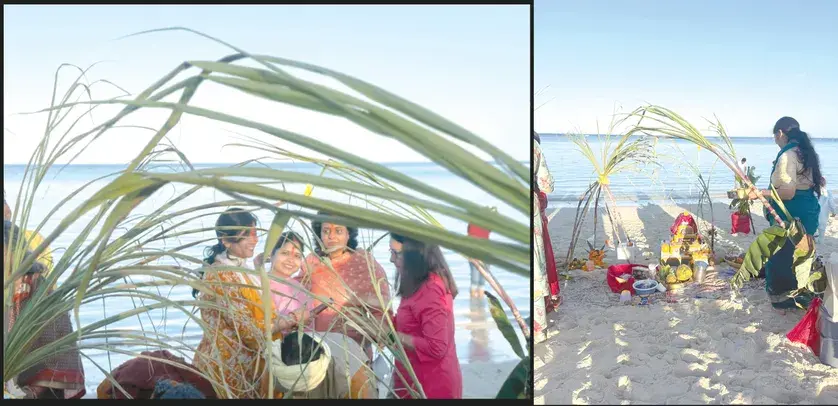
Among my most treasured memories are the celebrations along the shores of Mauritius, particularly at Flic-en-Flac. During Sandhya Arghya, the setting Sun bathed the ocean in golden hues as devotees gathered on the shore with traditional offerings and prayers. The following morning, during Usha Arghya, they returned to welcome the rising Sun as its first rays illuminated the horizon. Familiar Chhath songs mingled with the gentle murmur of waves and the fragrance of prasad filled the air. For a moment, the vast ocean seemed to merge with the familiar riverbanks and village ponds of my childhood. The setting had changed, but the spirit remained the same. It seemed a little of Bihar had crossed the ocean to find a home in Mauritius. In collective devotion, geographical distances dissolved into a shared experience of faith and belonging.
During the festival, another memorable occasion was the Chhath celebration on Kharna, the festival’s second day, at Brindaban Sarvajanik Mandir, Palma Road, Quatre Bornes. The occasion was graced by His Excellency Mr Dharambeer Gokhool, President of the Republic of Mauritius and the First Lady.
I was especially touched to see the First Lady applying sindoor (vermilion) in the traditional eastern Indian style, extending from the parting of the hair towards the nose. This familiar gesture evoked an immediate sense of cultural affinity, reflecting how traditions carried across oceans continue to be cherished by successive generations.
I was also privileged to make a brief presentation on the significance of Chhath Puja at the gathering. At its conclusion, the Hon’ble President remarked, « You presented it very well. You spoke very well. » His words touched me deeply. I received his appreciation with the warmth one associates with the encouraging words of an elder.
The occasion remains deeply personal and unforgettable. A festival inseparable from my childhood in Bihar had brought me, years later, to Mauritius, where I could share its meaning and beauty with a wider community.
Flavours of Home, Memories Across the Ocean
Few things capture the spirit of Chhath better than its traditional offerings. The aroma of freshly prepared Thekua evokes memories of childhood kitchens and festive preparations. Seasonal fruits, sugarcane and sweets reflect the festival’s bond with nature and the harvest.
A delightful discovery for me in Mauritius was finding sweets resembling Khaja and Balushahi in local sweet shops, though their local names remained unknown to me. Their familiar shapes instantly transported me to my childhood in Bihar. Thousands of miles from home, they reminded me that familiar flavours can bridge even the widest ocean.
A Tradition That Travels:
A Faith That Endures
Recognising Chhath’s cultural significance, India is pursuing its inscription on UNESCO’s Intangible Cultural Heritage list, supported by Mauritius, reaffirming a shared commitment to preserving this cherished tradition.
From the riverbanks of Bihar to Delhi’s Yamuna and to the pristine shores of Mauritius, the festival of Chhath has remained a constant in my life. Its timeless songs and rituals transcend borders, connecting generations through faith and belonging. To me, it will always be more than a festival – it is my childhood melody and a sacred bond with my roots. My experiences in Mauritius reaffirmed that oceans may separate lands, but heritage unites hearts. May the goddess fill every home with peace, hope and joy! Jai Chhathi Maiya!!
* Mrs Kamalika Mishra is a freelance writer with a keen interest in India’s culture, heritage and stories connecting generations. During her stay in Mauritius, she engaged with cultural celebrations and initiatives organised by the High Commission of India and the Indian diaspora. The views expressed are personal.