
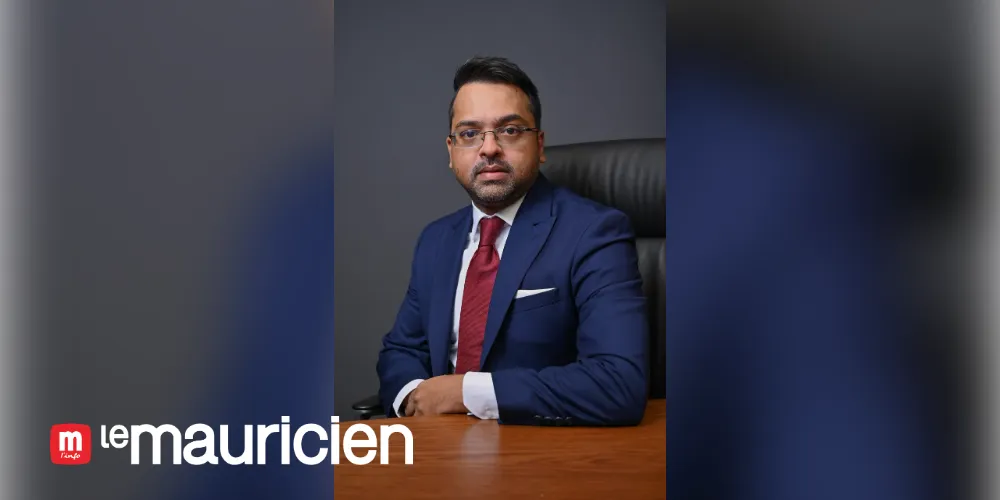
By Jayvash Nundoo, Head of Asset Management at SBM Capital Markets Ltd and SBM Mauritius Asset Managers Ltd
Here is a pattern we have watched repeat throughout our entire careers. A genuine shift in the economy begins quietly. For years, almost no one cares. Then one day it acquires a name, the magazines discover it, the crowd rushes in, and the price that was cheap for a decade is suddenly expensive overnight. Our job, as we see it, is to be early and then to be patient; to own the change before it is fashionable and to stay put long after the excitement has moved on.
Our investment philosophy is built around a simple observation: the most attractive long-term opportunities are often identified years before they become obvious to the wider market. At the same time, we recognise the importance of risk management, diversification and benchmark awareness. Balancing these objectives requires a portfolio structure that can participate in transformational growth opportunities while remaining resilient across market cycles.
To achieve this, we adopt a core-satellite approach. The core is deliberately “dull”. It is mostly broad index and active Exchange Traded Funds (ETFs) spread across sectors, geographies, and the great companies of the world, and we choose it for liquidity, breadth, scale, and low cost. We do not ask the core to be clever. We ask it to keep us invested in global growth and to spare us the unforced errors related to over-concentration and the single bad stock that quietly wreck otherwise sensible portfolios.
While AI-related equities and healthcare are where much of our conviction lives at the moment, we have been careful not to let the core become a one-way bet on either. It stays diversified across high-quality leaders we pick for the qualities that actually endure: real innovation, robust balance sheets, durable margins, genuine cash generation, and competitive advantages that do not evaporate the moment a rival shows up.
Around that foundation sit the satellite allocations. This is where we express our highest-conviction views and where we expect the bulk of our excess return to come from. Here we hold direct equities, active funds, and thematic ETFs, and we pick the instrument to fit the idea, not the other way around. When we believe in one specific business, we buy the business. When we want a whole trend more than any single name, we use a thematic ETF and move on. Simple tools, used honestly.
Underneath all of it sits a single conviction: the world economy is living through several deep, long-lived transformations at once. The real fortunes, in our experience, are made not in the products everyone can see but in the unglamorous foundations that make those products possible.
Semiconductors are the clearest example, and the timing has served us well. We were buying chips before artificial intelligence was a fashionable word. We began in early 2022, and AI had nothing to do with it. Our reasoning was almost boring: connected devices, automated factories, the migration to the cloud, cybersecurity, faster networks, and electric cars were all going to demand more computing power every single year. Every one of those shifts meant years of structural demand for advanced chips, memory, networking gear, and the extraordinary machines that make them.
Then AI arrived in force and did us an enormous favour: it proved the thesis we already owned. It did not change our map. It lit it up. We remain concentrated on what we call the enablers: the chip designers, the equipment makers, the networking specialists, the memory suppliers, and now the power and cooling systems. Many such businesses sit on genuine chokepoints, protected by complexity and by barriers no newcomer can overcome. They get paid on the total scale of AI investment rather than on whether any one app or model wins.
Memory is the critical link in that chain, and it is being quietly transformed. The appetite of modern AI has rewritten the economics of high-performance memory, especially high-bandwidth memory. What the market once dismissed as a commodity now behaves like scarce, strategic technology. We have not forgotten that memory is cyclical; it always has been, and it always cuts both ways, but we believe structural demand colliding with undersupply has tilted the odds firmly in our favour.
And we are already on the lookout for the next emerging opportunities. The bottleneck never sits still. As compute scales, the binding constraints shift from raw processing toward how efficiently data moves and how economically systems are powered and cooled. The old answer to moving data was metal wiring; the better answer increasingly involves carrying information as light rather than electrons. We are quietly building conviction in the enabling technologies that address those emerging bottlenecks before they become widely recognised investable themes.
We also own a little quantum computing, and we own it with a light touch. We treat it as a lottery ticket bought with sober eyes: small enough that a loss will not hurt, large enough that a breakthrough will delight. That is the appropriate way to own the future before it arrives.
Technology is our largest conviction by a wide margin, but we refuse to let it become the entire book. It has a nasty habit of moving as a single herd, yanked up and down together by interest rates, liquidity, and the mood of the market. The moment you most want something that marches to its own drum is precisely the moment the herd stampedes.
GLP-1 therapy is our answer to that. The obesity and diabetes story is compelling enough on its own merits, but the deeper attraction is that healthcare answers to a different master entirely. Its demand comes from demographics and from health needs, not from the business cycle or corporate spending plans, so these holdings steady the ship while still growing handsomely. We would rather find our resilience in businesses that are still compounding than hide in the tired, low-growth defensives.
And we keep one eye on price the whole way down the road. Not every theme deserves a permanent place in the portfolio. When momentum, improving fundamentals, or a violent dislocation hands us a shorter-term opportunity, we will take it without apology.
Uranium and space are how we proved that in practice. In uranium, tightening supply met firming demand and renewed political backing for nuclear power, the sector repriced hard, and we rode it up. In space, capital poured into rockets, satellites, and orbital commerce while actual profits stayed thin on the ground but the momentum was real, and we participated. Then valuations ran ahead of fundamentals, the risk and the reward changed, and we sold both and moved the money into better long-term ground. The lesson outlasts the trades: conviction is not a marriage. Capital must keep flowing to wherever the best opportunity sits today, not where it sat last year.
We do all of this with our eyes wide open. Slowing growth, stubborn inflation, central banks changing their minds, geopolitical shocks; these will hand us stretches of fear and dislocation, and they always do. What we do is stay consistent: keep our exposures aimed at the long-term winners, stay diversified, and hold our nerve. When the fundamentals rest on durable demand and scarce supply, sitting out because the headlines are ugly costs far more than it ever saves.
In the end, it comes down to one balancing act: ambition against discipline. We want portfolios pointed squarely at the transformations that will define the coming decade, and we want them diversified, valuation-aware, liquid, and tough enough to survive the market’s periodic loss of nerve. Spotting a good theme is the easy part and anyone reading the news can do it. The hard and valuable work is building a portfolio that can chase that theme with conviction and still be standing when everyone else is running for the exits.
That, in a sentence, is the whole of it: strong conviction, disciplined construction, and the patience to let the two of them compound. Everything else is detail.
About the author:
Jayvash Nundoo is a seasoned finance professional with nearly 14 years of experience, currently overseeing the investment management and advisory arms of SBM Capital Markets Ltd and SBM Mauritius Asset Managers Ltd (“SBM MAM”).
As Head of Asset Management, Jayvash has redefined the investment philosophy and framework, and is responsible for the overall investment strategy while also leading business development and sales, product innovation, and client engagement. He started his career as an analyst at a local asset management firm and has also been a part-time tutor in economics, finance, and investments before joining SBM MAM as Fund Manager.
Jayvash holds an MSc in Financial Risk Management from the University of Glasgow, United Kingdom, and a BSc (Hons) in Economics and Finance from the University of Mauritius. He serves as Executive Director on the boards of SBM MAM and several funds, including SBM Africa Equity Fund, SBM Maharaja Fund and SBM India Opportunities Fund.
This article is for informational purposes only and does not constitute financial advice, an offer, or a solicitation to invest in any product or fund managed by SBM Mauritius Asset Managers Ltd and/or SBM Capital Markets Ltd (licensed by the FSC). References to specific sectors, themes, or historical market timing carry higher volatility and are for illustrative purposes only. Investors should consult professional advisors and review official fund offering documents before making any investment decisions. SBM Mauritius Asset Managers Ltd and SBM Capital Markets Ltd accept no liability for any loss arising from the use of this content.

