

By Jovin Hurry Sustainability Strategist
From 9 to 20 November, the resort city of Antalya in Turkey, becomes the planet’s most improbable global village. An estimated 100,000 participants from 196 countries will enter COP31, the 31st Conference of the Parties (COP) to the United Nations climate treaty.
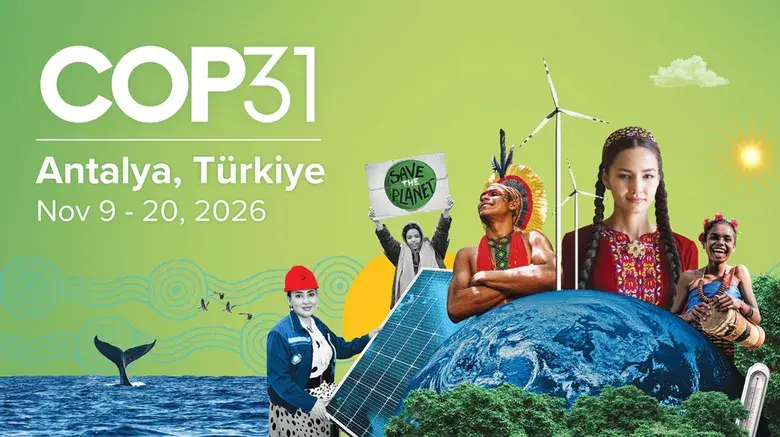
Common ground is rarely level
The overall basic idea is simple enough. COP is not a one-off event but the final leg of a year-long relay. Every year, the countries that signed the 1992 climate treaty meet to check whether they are doing what they promised. The nuance is in how they decide. Nothing passes by a majority vote.
Decisions need broad consensus, not unanimity, which is a gentler way of saying that nearly 200 governments must be persuaded not to object. That one rule explains most of what looks absurd from the outside: the overruns, the vague wording, the sentences that take a night to write. Back in June, diplomats met in Bonn to agree what would even be on the agenda, because in this world, arguing about what to argue about is a job in itself.
The COP is really two events: One is the formal negotiation, which produces decisions. The other is the Action Agenda, a track begun in 2014 where companies, cities, banks and universities announce voluntary commitments.
The first has rules and consequences. The second has enthusiasm and photo opportunities. Both will happen within walking distance of each other, and visitors regularly confuse them.
Country Pavilions showcase their best stories, almost.
These pavilions are the most visited part of any COP and yet, are the least understood. Each country showcases its climate story, targets and partnerships. These national stands buzz like a marketplace of ideas. Antalya will be a big marketplace indeed, with 200+ applications approved. I realised eventually that each pavilion is like a shopfront, where the glossy screen tells me the story a government wants to tell, while the conversation over tea at the back, sometimes tells me the one it doesn’t.
Ideas overflow at hundreds of simultaneous side events
In a festival-like atmosphere, scientists, CEOs, activists and young leaders use side-events to present breakthroughs, push narratives and pressure negotiators from the margins. Attendance is wildly uneven with some sessions attracting barely a dozen listeners while others spill out of the meeting venues.
I learned that queuing lines, lunch tables, WhatsApp/Signal groups and informal chats after events often become the real networking. I predict Turkish tea and baklava will become diplomatic currency.
I also learned that while side events are not where decisions are made, they are where decisions get their vocabulary. This is why I sit near the door, stay for the Q&A, and unhesitatingly pick the brains of the experts afterwards. I am always reminding myself of who is in the room, since some events are led by industry, and a polished panel is not the same thing as a policy.
The Blue Zone is the official space for negotiations
In this high security venue, nested like Russian dolls are the COP itself, the meetings of the parties to the Kyoto Protocol and the Paris Agreement. The Paris Agreement of 2015 set the famous 1.5°C goal, and every five years each country must hand in its homework, a national plan known as an NDC, the Nationally Determined Contribution.
I have seen that the plenary is mostly theatre and rubber-stamping since the real work happens by negotiators in many small, windowless rooms, topic by topic. Negotiators rarely speak for themselves. They speak for blocs: the big developing-country group, the small island states, the African Group, the European Union, etc. For a tiny country like Mauritius, its best weapon hence is to stand behind a bloc and let it speak for everybody.
Inside the Blue Zone sit the plenary halls, the biggest one with the president and the famous gavel, discussion rooms, a media centre, UN offices, side-event spaces, delegation offices and the pavilions. The Blue Zone, with limited access, is for leaders and diplomatic delegations, while the Green Zone is open to accredited participants. The two have different moods. The Blue Zone is hush and hurry, and the Green Zone is conversation and snacks.
The Green Zone welcomes the rest of the world
The Green Zone is more of a festival than a fortress. This open space invites companies, universities and civil society to show their solutions. The Action Agenda, started in 2014, gathers here the voluntary commitments from this colourful panoply of concerned stakeholders.
Turkey has chosen ten priorities for its Action Agenda 2026. They are zero waste (with a target to halve the projected growth of solid waste), oceans and seas, food security, climate-resilient cities (cutting building energy use by 25%), a “Climate Implementation Bridge” to link pledges to financing, youth and education, green industrialisation, clean energy (electricity at 35% of global energy demand by 2035), Rio synergies on climate, biodiversity and desertification, and resilient health systems.
Few people take notice of the word voluntary here. This means that nobody can be forced, so these pledges, in contrast to the ones in the Blue Zone, are cheaper than decisions. They are valuable nevertheless, but I read them the way I would read a New Year’s resolution: encouraging, ambitious, and best judged in a year’s time.
Antalya is to make a splash by making no trash
Every COP host wants to leave its signature behind. Antalya’s looks like zero waste, plus very good food. All operations in both above zones are meant to follow a zero-waste approach, with a Zero Waste Museum in the Blue Zone, an Experience Center in the Green Zone, and gastronomy houses under a “7 Regions 7 Kitchens” project. The Green Zone will also host themed hubs, from climate finance and startups to youth and “COP-Art,” under a 116-metre COP31 Tower that will stage light shows. Realistically, running a 100,000 person event on zero waste is either visionary or fearless. I’ll find out which on day three.
Global leaders sign agreements in disappearing ink
The Leaders’ Summit is on 11 and 12 November, with a separate VIP entrance for leaders and their three-person delegations, and nearly 120 heads of state and government are expected. The veterans tell me the speeches matter for the headlines, not the text. The text is made later, in the rooms upstairs.
COP texts have a secret vocabulary. “Decides” and “requests” carry real weight. “Invites,” “encourages” and “urges” are polite suggestions. “Takes note” often means “we couldn’t agree, so we’ll pretend we’re recording a fact.” And “historic” is what we call any outcome that has finished. When I read a headline announcing that countries “welcomed” something, I check what the verb really is.
What is on Antalya’s table is that last year in Belém in Brazil, governments called for tripling adaptation finance to about 120 billion dollars a year, but only by 2035, and failed to agree on a fossil fuel phase-out despite demands from more than 80 countries.
Small island states called the outcome very imperfect, which in diplomatic language is a polite scream. Antalya inherits that unfinished business, along with a dedicated session on climate finance for small island developing states.
Arguments drag because nobody likes a change in climate.
In that unfinished business, there’s often an “agenda fight,” since countries must agree what to discuss before discussing it, and negotiators are trying to reach consensus on more than 100 separate agreements. Observers can sit in on some sessions: plenaries, informal consultations and contact groups are generally open to them, while the “informal-informals” are often closed. That closed-door format is the true engine room.
Talks often continue all night in the final 48 hours, fuelled by coffee and adrenaline. I stay until the end as I saw that the final hours teach more than the first ten days. At COP28 in Dubai, as I described (in “COP28 & Beyond: On the need to be completely honest” in Le Mauricien (Forum), 24 Feb 2024) the mood in the last hours was jitters, edginess and exhaustion, and the media centre was the one place coming alive while everywhere else emptied.
Usually, by the last Sunday morning, a document will exist, a gavel will fall. Over this final sprint, the world will have tried, imperfectly and in dozens of languages, to agree on how to share a single atmosphere. It is messy, human and oddly hopeful, and that is the best reason to pay attention.
A Mauritian should care
Because we are the textbook case. We contribute about 0.01% of global emissions, yet sit squarely in the path of what everyone else emits. Yes, we know this in our bones: the 2013 flash flood in Port Louis, Cyclone Belal in 2024, beaches that shrink a little each year, and the Wakashio spill of 2020, which reminded us that the ocean is both our workplace and our liability. Yes, we administer an ocean more than a thousand times bigger than our land, and run a tourism economy that sells the very beach we are losing.
COP remains the only room where nearly 200 countries must listen to each other, and where the island speaking last gets the same microphone as the giants. Mauritius should use its microphone well.
Mauritius will go with a small delegation and a big stake, so every room we’re not in is a decision made without us. When the final text lands, I will look for three things: money for adaptation, money for loss and damage, and a date for coal. Everything else is decoration, however nice the baklava.
