Vrindavanee Bhujun-Kutowaroo
BEng( Civil) MBA (UK) Registered Professional Engineer of Mauritius. Secretary, Lucky Child Special Education Needs Association
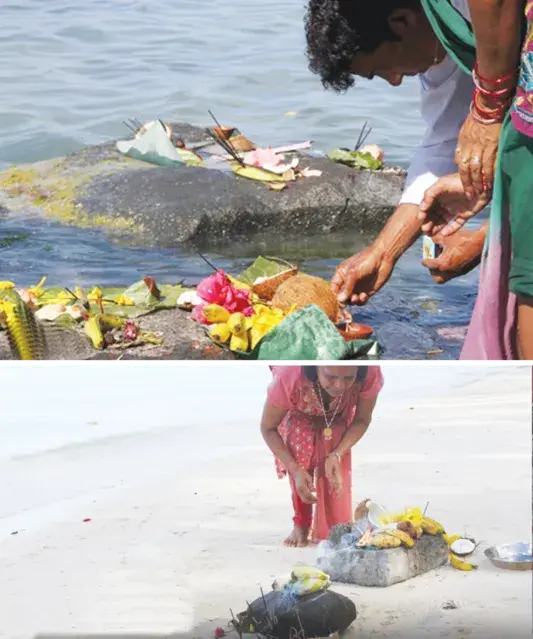
On a Mauritian morning marked by the light of the rising sun, families make their way towards the coast. Some carry flowers, fruits and other offerings; others come with parents or grandparents, bringing children who may be experiencing the observance for the first time. Prayers are said, the sea is approached with reverence, and devotees enter the water for a ritual bath. This is Gangasnan, a tradition that connects Mauritian Hindus with a sacred geography far beyond the shores of our island.
The word snan means bathing, while Ganga refers to the sacred river revered in Hindu tradition as a source of life and spiritual nourishment. Gangasnan is commonly associated with Kartik Purnima, the full-moon day of the Hindu month of Kartik. The observance is connected in popular religious tradition with the story of King Bhagiratha, whose intense penance is said to have brought the celestial Ganga to Earth. Religious observances became part of the island’s cultural calendar and, in many places, a means of bringing families together.
For generations of people of Indian origin in Mauritius, the observance has acquired a distinctive island expression. We do not have the Ganges flowing through our towns and villages. Instead, devotees gather beside the Indian Ocean and perform their prayers at the seashore. The sea is not literally the Ganges; rather, the Mauritian practice reflects how a tradition travels, adapts and finds meaning in a new home.
Rigveda 10.9 is a hymn addressed to the waters, often known as the Apah Sukta. Its verses describe water as beneficial, nourishing and associated with health and well-being. The hymn asks that waters bring strength and healing. One verse, Rigveda 10.9.4, prays that the waters may be beneficial for drinking and bring well-being; verse 10.9.7 asks for protection and healing for the body.
There is also a verse that invites thoughtful reflection. Rigveda 10.9.8 asks the waters to carry away whatever wrong or harmful conduct the worshipper has committed, including falsehood. Read superficially, this might suggest that a bath can simply remove wrongdoing. But a prayer is not a licence to repeat the same wrongs. Its deeper ethical force lies in the worshipper’s recognition of error and desire to change. If I have spoken falsely, harmed another person or acted unjustly, the meaningful response is not merely to enter water; it is to acknowledge the conduct, make amends where possible and resolve not to repeat it. The ritual can mark that intention, but it cannot replace it.
This distinction is important when we consider the reformist teachings of Maharishi Dayanand Saraswati. In Satyarth Prakash, Dayanand calls readers to examine religious claims through reason and the authority of the Vedas, rather than accept every custom simply because it is old or popular. An Arya Samaj approach encourages us to distinguish between the spiritual value of prayer and the assumption that an external act automatically changes a person’s moral condition. The point is not to ridicule devotees or dismiss a cherished observance. It is to ask what understanding, conduct and social good should accompany it.
From this perspective, Gangasnan can be meaningful when the bath becomes an expression of gratitude, humility and a renewed commitment to live rightly. It should remind us to speak truthfully, treat others fairly, care for our families, fulfil our duties and act with compassion. A person cannot wash away dishonesty while continuing to deceive; nor can anyone claim spiritual renewal while deliberately harming another.
This is a message that can resonate with young Mauritians. Generation Z has grown up in a world of instant communication, rapid change and constant questioning. Many young people are comfortable challenging inherited ideas and asking whether institutions and traditions remain relevant. That questioning should not automatically be regarded as disrespect. A living tradition should be able to explain itself, welcome sincere questions and show how its values connect with contemporary life. Young people should not be asked to participate only because their parents or grandparents expect them to. They deserve to understand why the observance matters.
The first reason is identity, understood not as a boundary separating one community from another, but as a source of belonging. In a multicultural country such as Mauritius, young people can take pride in their family histories while respecting the histories of others. Knowing the meaning of Gangasnan helps them understand the journeys, sacrifices and hopes of earlier generations. The young person who asks why a prayer is said, why flowers are offered or why the full moon matters is not weakening the tradition. That person is beginning to make it their own.
The second reason is the environment. For young people who speak with urgency about climate change, biodiversity and sustainability, the symbolism of water should lead naturally to action. Mauritius is surrounded by the ocean, yet the beauty of our coastline cannot be taken for granted. Plastic waste, careless disposal of offerings, pollution and damage to marine habitats undermine the very environment that gives this observance its setting. It would be contradictory to gather in reverence beside the sea and leave rubbish behind. Respect for water must be visible in what we do before, during and after the ceremony.
Religious and community organisations could make environmental responsibility a practical part of the occasion. Families and youth groups might organise a short beach clean-up, provide clearly marked waste facilities, avoid non-biodegradable decorations and explain why offerings should never become litter. Organisers could work with relevant authorities and environmental groups to protect sensitive coastal areas. A clean beach is not an optional extra to a celebration of water; it is one way of expressing the gratitude that the prayers themselves encourage. The responsibility begins with each household and extends across society today.
The third reason is community. Gangasnan brings people together across generations. In an age when much social interaction takes place through screens, a shared morning outdoors has its own value. Young people can help elders, assist with arrangements, learn prayers, ask questions and take responsibility for keeping the gathering safe and clean. They can also contribute their skills in photography, communication and digital media, provided that the observance is not reduced to a backdrop for online content.
Parents and elders have an important role in making that conversation possible. Instead of insisting that young people follow instructions without explanation, they can share what Gangasnan meant to them when they were young. They can explain the stories, the prayers and the memories associated with the day, while acknowledging that customs may evolve. Young people, in turn, can listen with curiosity and offer ideas for making the gathering more inclusive, environmentally responsible and accessible. This exchange is how tradition remains alive: not through repetition alone, but through relationship.
We should also remember that the ocean is not a substitute for the practical responsibilities of protecting water resources. Ritual bathing must be undertaken with attention to tides, currents, weather and official safety advice. Children should remain under close adult supervision, and no one should enter dangerous waters to fulfil a religious practice. Respect for nature includes recognising its power and limits. The sea is beautiful, but it is not without risk. Care for human life must remain central to any public gathering at the coast.
Ultimately, the value of Gangasnan should be measured not only by the number of people who attend or the ceremonies performed, but also by the thoughts and actions that follow. Does the occasion encourage gratitude for water? Does it strengthen family bonds? Does it inspire honesty, compassion and service? Does it leave the beach cleaner than it was found? Does it give a young person a reason to learn, question and carry forward a meaningful part of Mauritian heritage?
For Generation Z, the invitation is simple: come to the shore, learn the story, ask questions, share the experience with your elders and take responsibility for the environment. You do not have to switch off your curiosity to connect with your inheritance. Nor should participation end when the ritual bath is over. Let the experience encourage you to conserve water, reduce waste, respect the ocean and act with integrity in everyday life.
Gangasnan reminds us that water sustains every generation, regardless of age, background or belief. The Ganges belongs to a sacred story that travelled across oceans and found a home in Mauritius. The Indian Ocean gives that story a local setting and a responsibility of its own. If we approach the observance with understanding, ethical purpose and environmental care, it can remain more than a remembrance of the past. It can become a shared commitment to the future: a tradition renewed by each generation, and an island heritage worthy of the waters that surround us.