
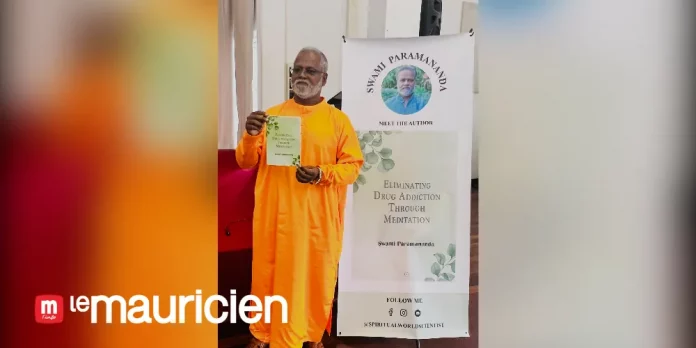
By H. Swami Paramananda
What can stop such a scourge as road accidents? Is it laws that can restrain the recklessness of drivers? Can stricter laws alone solve the problem? Experience seems to show that, however necessary laws may be, they cannot by themselves transform the mentality of people. The more moralistic and academically educated we are, the more uncivilised we appear to have become. If education is not enough to deal with road accidents and other social ills, then what else can truly transform us? A time will come – and I am afraid it already has – when, without laws, we shall not even feel safe to leave our doorstep.
But first, we have to understand what we mean by education. Have we really imparted the education that makes people responsible and self-disciplined, whether at home, in public places or elsewhere? Or are we still taking high social status, brilliant academic qualifications and mastering of written and spoken languages, especially English or French, as signs of being educated? If so, then I think we are still very far away from understanding what education truly means.
The word education is commonly traced to the Latin roots educare, meaning to bring up or nurture, and educere, meaning to lead out. But to lead us out of what? Out of our unconsciousness, ignorance, selfishness, lack of consideration for others and so on, which are at the root of not only irresponsible behaviour, but of all forms of misery, conflict and disorder in human life.
It is not speeding alone that causes accidents and kills, but reckless driving resulting from our irresponsible attitude, lack of consideration for others and lack of awareness. Added to that, many drive under the influence of alcohol. Speeding undoubtedly increases the risk and severity of accidents, but a much deeper problem is the unconsciousness of people.
Have you ever wondered why we speak of ‘raising awareness’? Words, slogans, laws, shocks, warnings, advice and moralising can break our inertia and lethargy to a tiny extent, and that too only temporarily. Those who know a little about psychology know that man is more than 90% unconscious. Much of human behaviour is therefore habitual and takes place without conscious awareness. On top of that, our mind is already burdened with countless impressions, desires, fears and habits. This is why, again and again, we fall back into our old patterns of behaviour.
No matter how many laws we pass, we shall not be able to truly educate people. Through laws, we can only restrain them. What we need is an expansion of awareness, which brings greater intelligence and understanding. It is only then that virtues like responsibility, attentiveness, respect and care begin to manifest naturally.
Man is an aggressive and impatient creature, and this often leads him to drive carelessly, sometimes at excessive speed. Such tendencies can be transformed through an increase in awareness alone. Therefore, my insistence is not on mere words to raise awareness, but on the practice of awareness. There is a whole science to this. Responsibility, care and respect cannot be inculcated from outside. They are virtues that already form the intrinsic nature of man. However, they are deep within us and have to be churned and brought to the surface.
Although reckless driving and carelessness are major causes of accidents, together with inadequate driving experience in some cases, should we neglect other contributing factors? What about the poor condition of some roads, unlit sharp bends and roundabouts, and the lack of proper traffic signs and indicators in certain places? We must also consider the irresponsibility of some pedestrians. Some walk at night wearing dark clothes and become almost invisible to drivers. Others walk unconsciously on the road instead of using pavements, while some cross roads carelessly without sufficient attention to approaching traffic.
How many times have we narrowly avoided crashing into cyclists riding without front or rear lights? Many motorcyclists also appear to have little regard for traffic rules, sometimes expecting others to give way to them regardless of the circumstances. There is yet another factor that the authorities should look into: the improper adjustment of vehicle headlamps. Ideally, the beam should be correctly aligned so that it illuminates the road effectively without dazzling oncoming drivers. In Mauritius, improperly adjusted headlights can be a serious disturbance and an additional hazard, particularly at night.
Moreover, with our increasingly hectic lifestyles, many of us are constantly in a hurry. Yet our roads are narrow and, in many places, poorly designed – or, one might say, hardly designed at all. Many simply developed from roads that have existed since colonial times. And then there is the long-standing and largely unresolved problem of traffic congestion. People have to reach their workplaces, homes, hospitals, courts and other destinations on time, often despite considerable delays. It is certainly our responsibility to allow sufficient time for our journeys, but even the most careful planning cannot eliminate every unpredictable obstacle that arises on the road.
Driving should not be a problem or a source of constant stress, but rather a pleasurable activity. However, for this, we need the necessary facilities: sound road infrastructure, better traffic management, reduced congestion and, above all, properly educated drivers. There are many drivers who come onto the road just after passing the basic driving test, and once on the road on their own, they become reckless and disregard the rules. Passing a driving test demonstrates that one has acquired certain skills; it does not necessarily mean that one has acquired maturity, patience, consideration or responsibility.
Ultimately, the real solution to road accidents lies in creating more responsible, intelligent, respectful and compassionate human beings – whether they are drivers, pedestrians or cyclists. A few law-fearing citizens may become more careful because they fear punishment, but behaviour based solely on fear of the law cannot remain effective forever. The number of accidents here and elsewhere bears evidence to that. What we need is not merely people who obey the law when they are being watched, but people who behave responsibly even when no one is watching.
Let us therefore focus not only on stricter laws and penalties, but more importantly on right education. Laws may restrain behaviour, but do not transform mentality. Right education does – through an increase in awareness or consciousness.
- H. Swami Paramananda (Dr. (h.c.) R. Dassruth)
Email: mystery@globalmindtransformation.org
