
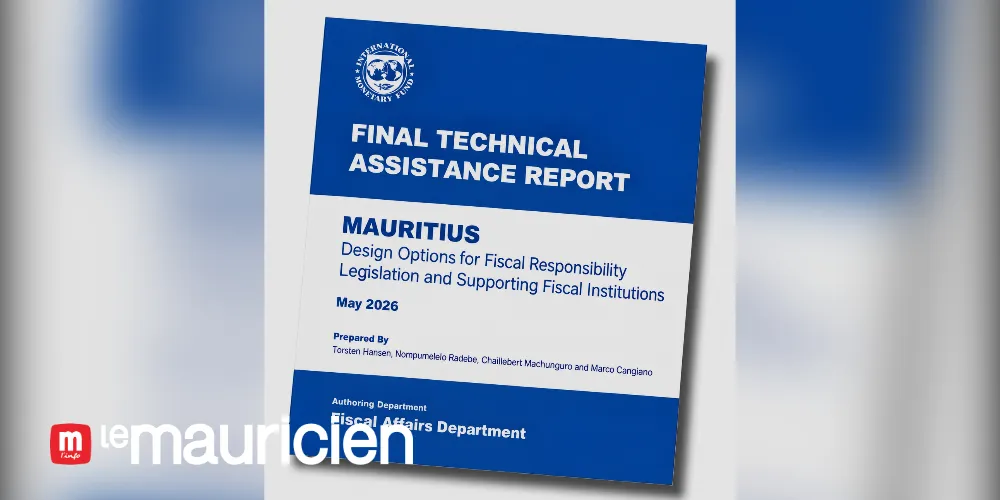
Un constat : « Fiscal outcomes have weakened markedly since the COVID-19 pandemic, with rising public debt, large budget deficits, and increasing exposure to fiscal risks »
La dernière étude en date du Fonds monétaire international (FMI) sur l’économie de Maurice, présentée sous forme de Final Technical Assistance Report, met l’accent sur l’urgence de doter l’économie d’un Fiscal Responsibility Bill et de Supporting Fiscal Institutions)pour mener à bon port le train de réformes envisagées sur le plan de la gestion des finances publiques. Ce rapport, daté de mai 2026 et rendu public par le FMI hier, se montre assez critique quant à l’évolution de la gestion budgétaire et financière au cours de ces derniers exercices financiers.
D’entrée de jeu, les experts du FMI notent que « Mauritius has achieved a strong record of economic development over recent decades, supported by sound institutions and prudent macroeconomic management. » Toutefois, cette même étude fait état de lacunes et de manquements constatés, d’où la nécessité de mettre en place le cadre légal nécessaire. «Fiscal outcomes have weakened markedly since the COVID-19 pandemic, with rising public debt, large budget deficits, and increasing exposure to fiscal risks. The new Government, which took office in November 2024, is committed to restoring sound fiscal policies to achieve fiscal sustainability in the medium term, underpinned by the introduction of Fiscal Responsibility Legislation (FRL) », indique l’Executive Summary du document officiel.
Le FMI reconnaît que le Public Financial Management Framework (PFM) comporte des points forts, dont, entre autres, un « well-established budget process, performance-based budgeting, improved fiscal statistics, and a statutory debt anchor ». Mais la mise en application de ces dispositions n’a pas donné les résultats escomptés. À ce titre, le constat du FMI est sans appel : « The Public Financial Management Framework has not been effective in enforcing fiscal discipline. The statutory debt limit has been breached repeatedly since its introduction in 2008, medium-term fiscal planning has been weakened by optimistic macro-fiscal forecasts, and fiscal reporting and risk management practices remain insufficiently developed to support credible fiscal rules. These weaknesses have contributed to persistent deviations between budget plans and outcomes, undermining fiscal credibility and accountability. »
Dans la conjoncture de réforme engagée sur le plan économique par le gouvernement de l’Alliance du Changement, le Fonds monétaire préconise une refonte complète, notamment en recommandant que « the new Fiscal Responsibility Legislation (FRL) should be designed as a comprehensive framework that integrates clear fiscal responsibility principles, fiscal rules, and strong procedural and transparency requirements ». Le nouveau cadre légal devra établir de manière formelle les « institutional roles and responsibilities, specify or require the setting of an operational fiscal rule consistent with the debt anchor—currently set at 80 percent of GDP—and expand the institutional coverage of fiscal rules to at least the central government ».
À cet effet, le Fonds monétaire invite le ministère des Finances à revoir les précédentes recommandations soumises en la matière. Il souligne que « to enhance credibility, the FRL should include narrowly defined escape clauses, well-specified correction mechanisms, and provisions for independent monitoring and assessment. Transitional provisions may be required to allow phased implementation as institutional capacity is strengthened ».
Pour atteindre l’objectif visé, Maurice ne devra pas se contenter d’un cadre légal, mais devra aussi être en mesure d’instituer des Supporting Fiscal Institutions et d’adhérer aux Public Financial Management Practices. « This includes improving the quality, transparency, and independent scrutiny of macroeconomic and fiscal forecasts; reconfiguring the Medium-Term Fiscal Framework (MTFF) to play a stronger strategic role in guiding the annual budget; and introducing an early, Cabinet-endorsed strategic phase in the budget cycle with ministerial expenditure ceilings », souligne le Fonds monétaire international.
Parmi les autres changements devant accompagner cette nouvelle étape dans la gestion des finances publiques, la Budget Circular devra être révisée. « There is also a need to develop a systematic framework for identifying, monitoring, and disclosing fiscal risks, including those arising from extra-budgetary entities, state-owned corporations, and litigation. The government should consider developing an overarching legal framework for extra-budgetary entities and state-owned corporations to enhance their governance, reporting requirements, and oversight and management », préconise cette étude, qui ajoute que « finally, fiscal reporting should be strengthened by enhancing the content of the MTFF document, publishing regular in-year budget execution reports, and conducting a mid-year budget review ».
Le FMI indique que les réformes envisagées en matière de gestion des finances publiques, avec un accent sur la Fiscal Responsibility, se traduiront par une consolidation de l’« accountability, will support adherence to fiscal rules, and help rebuild fiscal buffers over time ». À ce titre, le FMI soumet une série de recommandations pour la conception de la Fiscal Responsibility Legislation, en complément des réformes du Public Financial Management, afin d’encadrer le lancement de cette nouvelle étape.
Le FMI prévient encore que « appropriate prioritization and sequencing of the reforms will be critical » et que le rythme de la réforme devra tenir compte de la situation au ministère des Finances : « While there appears to be strong capacity in the MoF in terms of knowledge and skills, the number of staff is relatively low compared to bigger countries. » Les résultats prendront du temps, car « a Fiscal Responsibility Legislation is not a magic bullet and will take time to develop and implement, and getting it right should take prominence over getting it fast ».
Dans cette dernière perspective, le FMI propose un calendrier de travail au ministère des Finances : « An initial priority should be the detailed design and drafting of the FRL and the development of an implementation plan, which would also help inform needs for transitional provisions. » Cette étape pourra être achevée d’ici à la fin de cette année, en collaboration avec le Fiscal Affairs Department du FMI et AFRITAC South.
« In parallel, the Ministry of Finance should initiate work on strengthening macro-fiscal forecasting, as this would be foundational for the effectiveness of the Fiscal Responsibility Legislation once adopted. Similarly, initiating work to mitigate fiscal risks, including those arising from extra-budgetary entities and state-owned corporations, should be among the main priorities in the near term », indique le rapport de mai dernier, soulignant que « once the FRL is adopted, emphasis should be put on strengthening the strategic phase of budget preparation and the annual budget process, while efforts to enhance fiscal reporting for greater transparency could come at the tail end of the reform process ».