
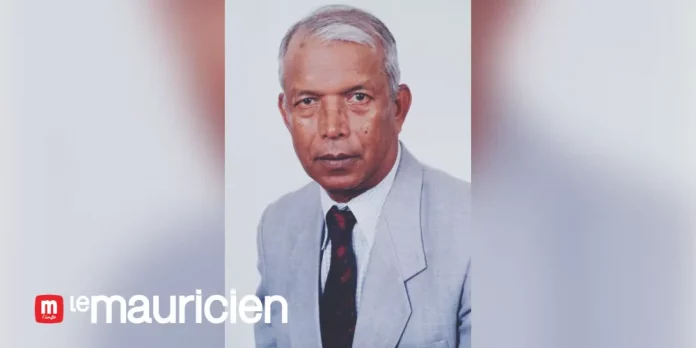
By Pahlad Ramsurrun
(Mr Anthony Greenwood was absolutely right when he had said that SSR was the main force behind the struggle movement for more than 20 years. This statement led one roughly to the election of 1948 that was held on the new provision known as ‘literacy test suffrage’ in the new constitution that was obtained by SSR from the UK Government in 1947. But it also means that SSR’s ‘Silent Mass Movement’ goes beyond 1948. It properly goes back to 1935, when SSR had ventured to publish his ‘Political Manifesto’ under the heading “Sons of Immigrants” that was published in “Indian Centenary Book” that was held to mark the Indian Centenary Celebration on December 29,1935 at the Dayanand Dharamshala at Port Louis.
Who was the man who had the audacity to liberate Mauritius on 12th March 1968 at noon, in the Champ de Mars, standing besides Sir John Shaw Rennie, the Governor of Mauritius – watching with curious eyes, the lowering of the Tricoloured Flag and the raising of the Four Colour Mauritian Flag, in the blue sky for the first time in the annals of Mauritian history?
Who was the man to become the architect of the nation, whose audacity could be mapped for the Independence Day Celebration which was held under difficult situation as the country was beset by fierce communal tensions and the presence of battleships and Marines were required to keep peace during the historic celebration when a new nation was born?
Who was the man who had swept away the over-powerful protagonists of the oligarchy and their system of government in 1948, for they had the upper hand in Mauritian affairs since 1832, and had instead, laid the foundation of a democratic system of government that was to blaze the trail for the Independence of the country?
Who was the man who had led a silent mass movement ever since his arrival on the shores of Mauritius in 1935, indulging in a fierce battle to obtain the literary test suffrage, then autonomous government, prior to the final liberation of the country?
That audacious man was no other than Sir Seewoosagur Ramgoolam, the Prime Minister of the newly independent country, the father of the nation, and, who had a precise knowledge of the then prevailing precarious situation in the country, and in order to avoid any mishap on that historic day celebration, he had sought and got the necessary disposition of troops from friendly countries like the United Kingdom, France, Australia, America and India.
Mr Greenwood was absolutely right when he had said that SSR was the main driving force behind the struggle movement for more than 20 years. This statement led one roughly to the election of 1948 when 11 out of 19 members of the SSR group were elected to form part of the Council of Government. This also means that SSR’s silent movement was successful in such a short time.
Here it is fair to mention for evaluation purposes, what was reported in the press regarding the arrival of Dr S. Ramgoolam on our shores after having spent a long time in the metropolitan city of London. The ‘Arya Vir’ and ‘Le ‘Radical’ had announced the arrival to be on 17th July, 1935. Barely a week after that on July 26,1935, the ‘Arya Vir’ of Pandit Cashinath Kistoe reported, “It is with much pleasure we received the visit to our office of Dr S. Ramgoolam M. R. C. S., L. R. C. P. (England) who returned to the colony a fortnight ago, after having completed his medical studies in England. We had a long conversation with the doctor and were greatly impressed by his fluent speaking…. We congratulated him on his success and trust that he will elbow out his way in the world with no little credit to himself and to those who have contributed to his success.”
The ‘Sanatan Dharmark’, on the other hand, had inserted a one-page article of small format on August 9,1935, entitled Dr S. Ramgoolam, and said among others – “ Nous avons appris avec beaucoup de plaisir l’arrivée du Dr S. Ramgoolam après quatorze ans d’absence passés en Angleterre… Le docteur est parmi nous aujourd’hui. Il est non seulement un médecin intelligent et des plus capables qui honorera le monde médical, mais il est aussi une belle valeur donc la communauté hindoue a bien le droit de s’enorgueillir”.
In his article ‘Sons of Immigrants’ published in the ‘Indian Centenary Book’ in March 1936, which was in reality, Dr S. Ramgoolam’s ‘Political Manifesto’, in which he had quoted several British and European writers and thinkers, namely T. S. Elliot, Shakespeare, Aristotle, Ruskin and H. G. Wells to support his arguments. Referring to the Indian workers for their “long accustomed to a life of toil, hunger and misery”, he had said, “it is difficult for them to grasp the meaning of the significance of the celebration of the centenary of Indian immigration”.
He also pointed out their weaknesses and their lethargic state in economics and politics, their disinterestedness in education, their attitude for being a slave to tradition and their excessive belief in religious dogmas. He pleaded in favour of education, saying, “from education to politics and economics it is not a long flight”.
He asked – “ How long must the Indo-Mauritian continue to live under unfair rule, when they are not enjoying voting rights? He rang the bell, “There is no shadow of doubt that the Governor should approach without further delay, the Imperial Government in London with a view to the revision of the present constitution on a more equitable basis “. He appealed for unity, “It is the crying need of the time that the two great bodies (Hindus and Muslims) that compose the Indo-Mauritian Community should walk hand in hand for the advancement of the people. For that, however, we must organise ourselves to the pitch of our ability. There must be a “Great Mass Movement” to achieve our ends.
He also referred to the salient features of Sir Frank Swettenham’s Report of 1910, and quoted several instances from that recommendations, especially, the one that became the ‘Magna Carta’ to the political aspirations of the Indo-Mauritians in this country, which reads, “No country can legitimately claim which does not contain a substantial proportion of members who represent that hitherto unrepresented community of Asian descent which plays such an important part in the life of the colony and comprises more than two-thirds of its population”.
In the end Dr S. Ramgoolam enumerated the qualities that were needed in the man who wanted to lead his community. First we must decide what is needful : we must cultivate the spirit of service, brotherhood, love and unity, we must not lose sight of ourselves in the cause we are championing and go to it with thirst, earnestness and humility. We must learn to serve the people before we could pretend to lead them”.
Because, it is only by the subordination of self and by selfless sacrifices and endeavors that this great community of Indo-Mauritians will be saved from being a burden into itself, and it is through these that will come unity, strength, and the hope of a happy community capable of great achievements like those of our forefathers in India.
In December 1938, Dr S. Ramgoolam led a delegation, composed of planters, workers and a few unofficial and leading members and met the Governor in his chamber. The Governor received the delegation with due honour and listened to their grievances. This was the first and sound political move of Dr S. Ramgoolam over which the reactionary press, controlled by the oligarch and other elements of the population, exploded like a bomb and criticized Dr S. Ramgoolam.
In November- December 1940, when Dr S. Ramgoolam became a nominated member in the Council of Government, and later, was elected a municipal councillor, the ‘ Arya Vir’ of Pt. Cashinath Kistoe inserted a one-page article on him. It said among others : « Dr S. Ramgoolam is the first Hindu who has been elected municipal councillor in a general election of the Municipality for the last fifty years”.
That election of Dr Ramgoolam must have given the lie to people who were making fuss of his unpopularity from the house-tops with the exceptionally few who are today in the vanguard of politics. It can be said that it will require the Indian masses a quarter of a century to understand the ins and outs of politics while acting in the spirit of time.
In 1946, during the first Constitution Consultative Committee meetings, witnessing the combative spirit of Dr S. Ramgoolam, Hon. Dr Edgar Laurent, the senior elected member of Port Louis had to comment on Dr S. Ramgoolam, “I never could have thought, I never could have expected that our friend (Dr S. Ramgoolam in 1932), whom I had met in London, with his usual shy and timid appearance, his usual gentle and suave manners would have, on his return to Mauritius, initiated in this country such a nationalist movement and that he would have given to it such an impetus which is unfortunately acquiring momentum everyday”.
In 1948, the general election was held on the basis of the new constitution. Dr S. Ramgoolam, Harilal Vaghjee and Aunauth Beejadhur were candidates from the same constituency in the North of the Island. On the eve, in ‘Advance’ on July 8, Aunauth Beejadhur wrote about Dr S. Ramgoolam: “Ramgoolam est incontestablement celui que tous voulaient revoir au Conseil non comme membre nommé mais comme député. Brillant dialecticien, il est de gauche, de l’extrême gauche même, d’une franchise déconcertante parfois, mais clairvoyante et juste. Le Dr Ramgoolam a été le seul qui fut dans l’opposition au Conseil durant les dernières années, le seul qui eut à braver les foudres du président”.
Au comité consultatif, il lutta de pied ferme contre les membres conservateurs et réussit à imposer ses vues au gouvernement. Le Dr Ramgoolam n’a jamais dévié de sa politique : “Socialiste il est, socialiste il restera”.
With the lowering of the suffrage, the number of voters increased from 11,437 to 71,230, and the outcome of the election held on July 9 and 10,1948, resulted in the election of a big number of Indo-Mauritian candidates (eleven out of nineteen). In the year that followed, Dr Ramgoolam became the leader of the Labour Party and through his initiatives, several Constitutional talks were carried in the British Parliament, e. g. in 1955, 1957, 1961 and 1965, and thus he was able to wring the formidable political weapon “Universal Suffrage” from the UK Government, with which, he led the country to Independence on March 12, 1968.
According to Reuters correspondence, more than 100,000 people were present in the Champ de Mars to attend the flag-raising ceremony, after which, 31 salvos, 16 by the Special Mobile Force, and 15 by the five battleships stationed in the harbour resounded in Port Louis.
The next day on, March 13, 1968, the Legislative Assembly was convened to proclaim and adopt the Mauritius Independence Order 1968 by the Governor-General. After the election of the Deputy Speaker in the person of Mr P. G. Rault and the Deputy Chairman of Committees, in the person of Mr R. Gujadhur. The Rt. Hon. Anthony Greenwood presented officially “The Constitutional Instrument” to Dr The Rt. Hon. Prime Minister Sir Seewoosagur Ramgoolam. Then, H. E. Governor General, Sir John Shaw Rennie G. C. M. G., O. B. E. opened the Parliament and read the messages of Her Majesty the Queen, and then delivered the speech from the throne.
Pahlad Ramsurrun
