KAVI VADAMOOTOO
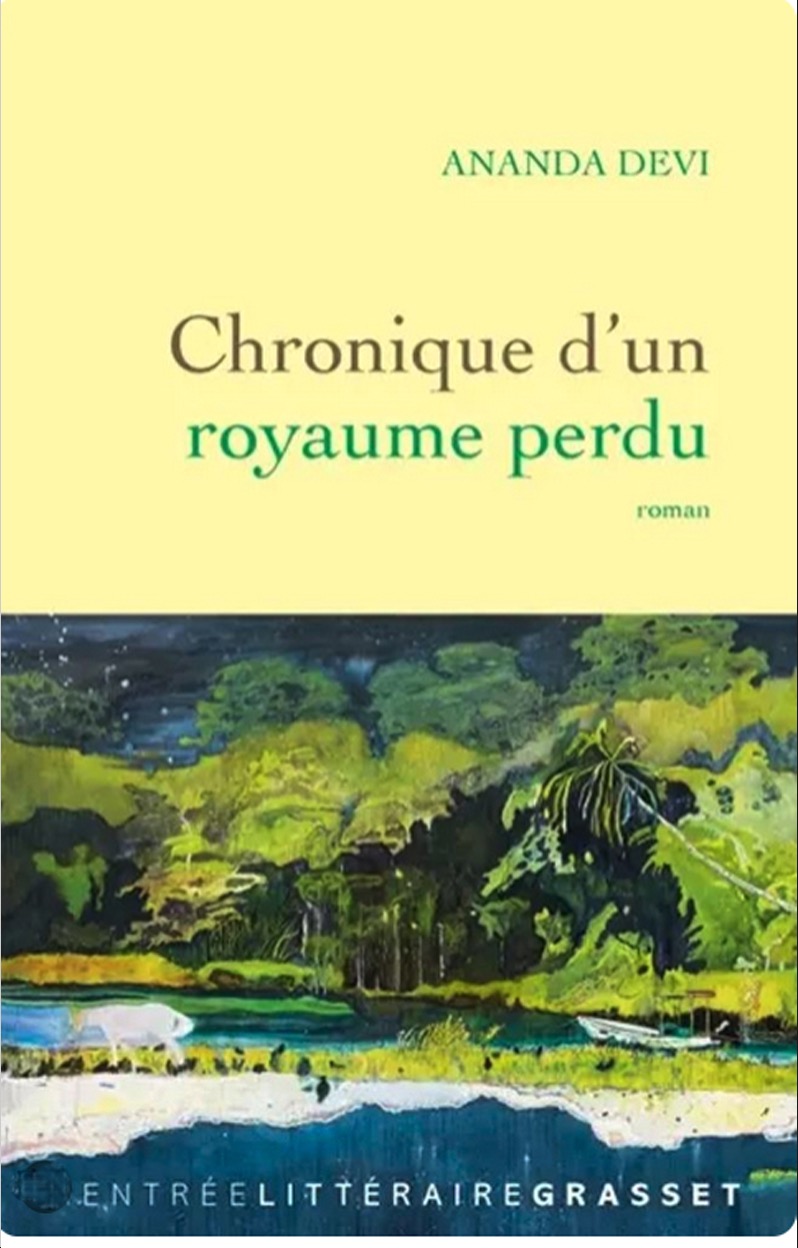
As I enter the violent, bruised worlds of Ananda Devi, I have to be honest about my perspective. I read her as a male reader, and that matters. Her work forces me to confront the long history of brutality and violence created by the male gaze. Her recent novel, Chronique d’un royaume perdu, makes this very clear. It follows four generations in the forgotten Mauritian village of Le Bouchon. At its heart is one haunting image: the unforgiving plantation soil under the bare feet of the colonised. It is not a novel that lets you stay comfortable. “I needed 40 years to write it,” said Ananda Devi in her correspondence to me. As an artist, I am interested in how the virgin surface of a canvas has to be broken for something to emerge. That is what draws me to Devi above all else: how her pen acts like a brush, how it strikes and ruffles the surface of each page.
When I reflect on her work, I keep returning to a simple, human question: what happens if we do not open our minds like a book to face and read the “shadows” within us that stare and dare us to confront our own potential for violence?
For Devi, the act of writing is an ethical imperative born from a refusal to look away. In Chronique d’un royaume perdu, this manifests through the figure of the quiet chronicler who records the days of struggle and nights of madness “to prevent oblivion”. When writers pass into silence, they become complicit in the erasure of suffering. The struggle to find “apt words to revive the silence of the mutilated bodies” is the central aesthetic and moral crisis of her work. Language must bear witness to the violated self and the fractured world. To write about violence is not to glorify it, but to reclaim the human dignity buried beneath layers of trauma. Without this harrowing confrontation, art risks becoming a facile escape rather than a mirror for our collective condition. Across her works – from the stark urban decay of Ève de ses décombres (Eve Out of Her Ruins) to Chronique d’un royaume perdu – Devi’s prose fiercely refuses that silence.
In Ananda Devi’s work, language itself feels alive. Violence is not just something that happens in the story – it pulses through the sentences. She bends and even breaks the usual rules of storytelling and grammar to reflect the raw reality of her marginalised characters. This linguistic and structural chaos exposes the very real friction between past community customs and the harsh patriarchal systems her characters must navigate.
Within novels like La Vie de Joséphin le fou and Pagli, this tension manifests through multilingual friction, where underlying languages fracture standard syntax to reflect the uprooting of native tongues. Similarly, in works such as Ève de ses décombres and Soupir she uses breathless syntactical lapses and portrays the city of Port-Louis as a living, breathing beast that envelops its trapped inhabitants. Furthermore, Devi’s prose often reveals sexual experience in a raw, unflinching way, without necessarily being punctuated by intimacy, love or tenderness. Her writing can be visceral, intense and unromantic, focusing intensely on the bodily, sensual aspects of experience. This unsparing style avoids traditional notions of romance in favour of harsher realities, highlighting power dynamics, violence and societal pressures.
Reading Chronique feels more like a profound physical and emotional jolt, transforming my presence into a deeply somatic event. As the male subject, I cannot occupy the comfortable position of the spectator who looks, analyses and safely touches the text or the female body from a distance. Devi shatters this safe distance by inverting the mechanics of penetration. Tapping directly into the Lacanian reverse-gaze – where the sovereign subject who believes he is looking suddenly realises he is being looked at, pinned down and judged by the visual field itself – the prose stops being something I simply observe. Instead, the text turns around, looks back at me and breaches my psychic skin. I feel myself being entered and touched, no longer just the one who watches, but the one who is figuratively stripped naked and unstitched.
Luce Irigaray’s idea of mimesis helps explain what Devi is doing. Irigaray says that if you are pushed to the margins, you don’t always have to run away from the dominant way of speaking. You can do something else. You can imitate it deliberately. You can copy it and push it so far that it starts to break. Devi does exactly that with language. Her target is not just the male gaze. It is the whole structure of male language, a language that describes, categorises and controls things from a distance. Devi shatters that polished surface by staying completely close to the chaotic, breathless reality of her characters. She turns grammar against itself. She takes the very tools that have been used to violate the “Other” – the aggressive gaze, the master-narrative, the language that penetrates and controls – and she throws them back at the reader. In her prose, the sentences themselves perform that violation. The neat, logical structures we rely on are torn apart. So the male reader who is used to being in control, watching safely from above, is no longer safe. He cannot just observe the trauma. He has to feel it himself, and is left speechless.
To understand what makes Devi’s approach so distinct, it helps to compare her with another feminist writer – Elfriede Jelinek. Jelinek’s method is cold and clinical. In books such as The Piano Teacher, she uses an icy, satirical distance. Her language works like a scalpel. She dissects voyeurism and patriarchal violence from far away, holding up a chilling, sterile mirror to the reader. Devi refuses that kind of safe distance. She does the opposite. Instead of a cold mirror, she seduces her reader in a furnace of passion and violent sensuality. Jelinek exposes power through detached cynicism. Devi’s breaking of language is not cold or cynical. It is warm, bruising and deeply empathetic. She does not let the male reader simply watch how power works from the outside. She makes him feel it – to bleed alongside the text.
This brings me to the psychological and feminist ideas behind Devi’s world. Four thinkers come to mind: Jacques Lacan, D.W. Winnicott, Simone de Beauvoir and Judith Butler. Lacan helps us see how language and power break identity apart. He argued that we first form a sense of self when we see ourselves in a mirror, and then we enter what he called the symbolic order – the larger system of language, law and social rules that governs us. Devi’s characters are trapped inside that system. It treats them as outsiders, and wounds them. But Devi does not leave them stuck there. This is where Winnicott is useful. Winnicott wrote about a transitional space – a raw, in-between space where we can meet the world directly, without protection. Devi’s prose creates that kind of space. It is harsh, visceral and uncomfortable. But that is the point. It acts like a transitional object, pulling us out of our safe illusions and forcing us to feel.
This connects directly to feminist theory. Simone de Beauvoir argued in The Second Sex that woman has historically been pushed into immanence – stuck in repetition and in the body – and cast as the “Other”, while man claims transcendence and freedom. Devi’s women live that reality. Trapped by poverty, geography and male desire, they are often denied any chance to move beyond their circumstances. Judith Butler takes this further, showing how gender is not natural but performed – we act out scripts that society writes for us. While Butler explores how oppressive power structures render certain populations invisible and therefore “ungrievable” – “lives that cannot be mourned” – Devi urges us on to challenge this invisibility, hence allowing it to be grieved. Her novels act as containing skins, albeit mutilated, to help us transition into a world where we lament the stolen futures of those whom colonialism and patriarchy have discarded and silenced.
This breaking apart of language and story connects to a much bigger historical problem: our struggle with Enlightenment humanism. That tradition has often tried to be too clean. It wants to be rational and polite, and so it refuses to look at the darker parts of ourselves. When we cannot make space for that darkness inside us, we lose the ability to have empathy for ourselves. And when we cannot bear our own shadows, we push them outward. We look for someone else to blame. That is how we fall back into the old, painful cycle of scapegoating. This is exactly what Devi’s fiction exposes. In Chronique d’un royaume perdu, she roots her story in generations of plantation trauma. In the village of Le Bouchon, the soil itself holds that history – its cruelty is pressed directly into the flesh of those who walk barefoot on it. Through images like that, Devi shows us how structural violence actually works.
Devi’s language is as brave and as brutal as the world she writes about. Because of that, its impact does not stay on the page. It spills over into us. It shifts how we feel and think. It wakes us up. For me, reading her is an invitation to unlearn. And that kind of unlearning requires vulnerability. You have to let your guard down. Her books take us through deep despair, but in the process she strips away old conventions and breaks open traditional literary forms. That breaking is necessary. It creates space for a new voice to emerge – a fierce and beautiful voice for those who have been silenced. That is why, even after all the darkness, her work does not leave us in despair. It brings us back with hope, and with a real desire for change, but after being emotionally stripped naked.