
Preamble
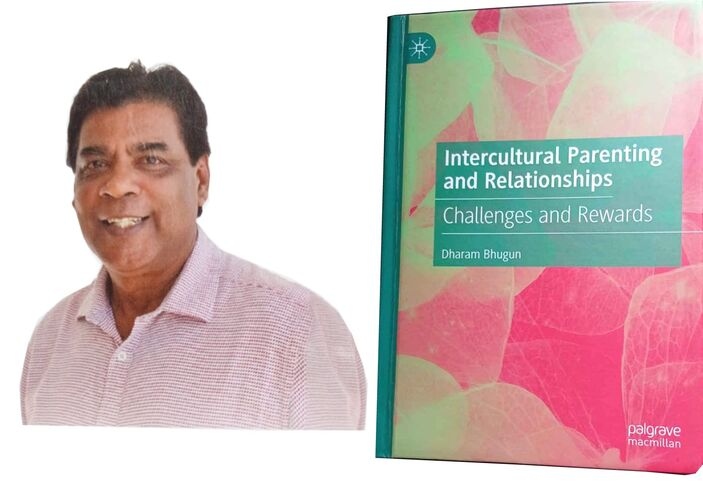
Dr Dharam Bhugun’s book, ‘Intercultural Parenting and Relationships – Challenges and Rewards’ was published in 2019 by Palgrave Macmillan, Cham, Switzerland. It is structured in six chapters as hereunder:
Introduction – defining intercultural, interracial, interfaith.
Intercultural Parenting and the Australian Context – multicultural policy.
Cultures Coming Together – falling in love across boundary.
- Power Relations, Reverse Acculturation/Enculturation – the theoretical heart.
Strategies for Making Intercultural Parenting Work – practical heart.
Implications for Theory, Practice and Policy.
He argues that intercultural parenting is moulded not just by culture but also by contextual and external factors such as individual and personality traits, the environment, gender and power, religion, socio-economic status, extended family, friends, and diasporic communities. This ecological view is primordial.
The Author
Dr Dharam Bhugun is born in Surinam, Mauritius. He is a scholar, educator, presently cosily ensconced in Perth, Australia.
He is a Psycho-Social Therapist at Realistic Counselling, Queensland and Guest Lecturer, Southern Cross University, Gold Coast, Australia; international author, contributor to peer-refereed academic journals, media columnist, radio and television commentator and actor.
Synopsis of the Book
Bhugun’s research question is lucid: Which challenges are encountered and which benefits intercultural couples earn: which strategies do they resort to in order to negotiate their differences and belongingness?
The research tool, questionnaire, is not used. Instead, he records intimate testimonies – lived experiences. Couples are interviewed where one partner is from Anglo-Australian background and the other from Asian, African, Indian diaspora; many narratives echo Mauritian mixed families.
Principal Contributions to Knowledge
(a) From Deficit to Strength: Beyond Negative Stereotypes
Mixed marriages have been portrayed as problematic by psychology over decades – higher divorce rate, identity confusion in children. However, Bhugun, like a genuine Mauritian, declines this claim. He opts for prodding the reader to ride beyond negative stereotypes to a more nuanced representation of the challenges as well as the benefits accruing from the phenomenon.
Rewards are shown as children being more open, bilingual, culturally enlightened, resilient, creative. They learn early what Gurudev Veervasantha teaches – truth is one, paths are multifarious. Intercultural children live that philosophy daily. Scholars, practitioners, students, intercultural couples, parents, families, and the wider community will gain from the deep and valuable insights into the challenges and successes depicted.
(b) Not Just Culture, Power too.
The next contributory element is the portrayal of how intercultural conflict is often not culture-induced but power-based. Who decides? This is gender and power. It is highlighted in his interviews that, when the husband belongs to the dominant Anglo culture, and the wife to a minority culture, the latter’s culture is often silenced and suppressed. In case the wife is more educated or economically independent, negotiation is at par. Religion is a crucial power domain. Socio-economic status also matters. Within the extended family, the diasporic community and grandparents can symbolise support or pressure.
(c) Reverse Acculturation/Enculturation – A New Paradigm?
This is seemingly Bhugun’s most original theoretical innovation stance.
Classical acculturation theory (John Berry, 1992) states that the migrant learns the host culture. Bhugun depicts the reverse happening. The Australian partner learns the minority culture. He dubs it reverse acculturation and reverse enculturation. The Anglo partner starts to cook dhal, curry, eat with hands, speak Hindi words, go to the mandir, become vegetarian on a weekday, listen to and watch Bollywood.
In Mauritius, this is current. A Creole (Christian) partner learns to make ‘sept cari’ for Maha Shivaratri, the Hindu partner learns to make ‘rougaille saucisse’ and dance sega, the Muslim partner learns ‘sega tipik’, and so forth. Interculturalism transforms both, not merely one. It creates a third space. While for teachers, this is powerful: inclusive classroom is not where the minority child becomes like the majority; however, it grows into a space where all children learn from each other – reverse acculturation as pedagogy.
(d) Strategies – How They Make It Work
Chapter 5 and the whole book are like a manual, a practical tool for living.
Five strategies are underscored by Bhugun which couples resort to in order to negotiate differences.
(i) Creation of a Third Culture
They do not choose his or hers; they create ours. New rituals emerge – Divali plus Christmas tree; Eid plus Easter; Bhojpuri lullaby plus English story. This directly links to works on mystic underpinnings of rituals – successful families sanctify new hybrid ritual.
(ii) Cultural Code-Switching
Just as we switch from English to KM (Kreol Morisien) and vice versa in multiple contexts, children learn to switch cultures – at ‘Nani’s’ house, one behaviour; at Grandma’s house another. This is competence, not confusion.
(iii) Negotiation and Compromise
There is fluidity; it is not fixed 50/50. Therefore, who decides varies with context, importance, child age.
(iv) Boundary Setting with Extended Family
Children learn to lovingly tell parents: this is our family now!
(iv) Universalist Spirituality
Many couples move from formal religion to universal spirituality. This is what Gurudev Veervasantha advocates and preaches. The focus is on values: respect, compassion, truth, rather than ritual orthodoxy.
Bhugun’s publication in 2023 – Managing Differences in Intercultural Relationships and Parenting – furnishes insights, tools and strategies to negotiate differences, resolve conflicts, and create common grounds – exercises, communication techniques, parenting plans. It is a definitive guide for current and future intercultural couples.
International Perspective on the Issues – Challenges and Rewards
The book provides Australian couples’ intimate testimonies, mirroring rich, variegated and very individual and personal experiences, which in turn yield and trigger innovations in theory and practice. The findings of the study can well be implemented by counsellors, therapists, as well as social workers to sharpen and refine their understanding of intercultural relationships and parenting.
The literature review and the findings of this investigation have unveiled the challenges and rewards of intercultural marriages and parents. It is, therefore, crucial that practitioners explore both these dynamics and, as a result, be better informed and more confidently equipped to empower their clients.
In spite of the fact that Bhugun’s study is way beneficial to our understanding of inter-cultural couples’ distinctive life challenges and strategies, it is based on the multicultural Australian context, which might not be safely and easily transferable to other parts of the world. It could be beneficial to explore how couples where both partners are migrants, deal with the challenges of their own culture, as well as the culture and context of the country they had opted for living in.
Limitations
The sample from which data have been collected, processed, analysed and inferences drawn by Bhugun is Australian, mostly middle-class and relatively educated. By contrast, working-class Mauritian reality – cane cutter, fisherman, factory worker in Surinam – may mirror dissimilar power dynamics, especially economic. Children’s own voices are limited; we hear parents about children not children themselves. Future research should take on board child perspective.
Relevance for Mauritius, MIE, and Open University
Mauritius is an excellent natural laboratory for Bhugun’s theory. However, we have no local study as yet. There is the need for a replication of his investigation in Plaines Wilhems, Savanne, Riviere Noire – with Hindu-Creole, Tamil-Telugu, Bihari-Marathi couples, and other intercultural unions.
For MIE trainees, this book should be read for the module, if any, on Multicultural Education. Teachers who understand intercultural parenting will not ask a learner: “Who are you? What are you? What worlds/cultures do you bring?”
For policy, The Ministry of Gender Equality and Family Welfare should implement Bhugun’s implications and principles for counselling mixed couples.
For Senior Citizens, willpower, resilience and perseverance are sine qua non. Intercultural parents direly need these three virtues. Loving across boundaries in a world that still erects walls requires willpower. To raise a child when two grandmothers pull opposite ways need resilience. To create a new culture when old cultures dictate “choose” requires perseverance.
Bhugun illustrates that these couples pose no problems to be resolved, but are artists of everyday life. They do in kitchens what mystics do in ashrams: they make and transform multiplicity into oneness.
For Mauritius, which still questions whether ‘vivre-ensemble’ is reality or slogan merely, Bhugun has a ready-made answer: “go and see kitchens of Surinam. It is already happening.”
This book is essential, transformative, Mauritian at heart. Love does not erase difference; love learns to hold difference – in one hand, ‘diya’; in the other, candle, both lighting the same child.
The End-Word
In the village of Surinam, Savanne district, before a child joins school, he has already lived interculturalism. He hears Kreol Morisien from his father; Bhojpuri from his grandmother, French on radio, English from MIE textbooks. His neighbour is Creole Catholic or Anglican, the next is Muslim, and the next is Tamil. This is our Mauritius.
In spite of all the talk of ‘nation arc-en-ciel’ and ‘vivre-ensemble’, it seems there is very scanty serious academic writing on what happens inside a ‘mixed house’. What happens when a Hindu mother and a Muslim father disagree on what religion the child should follow and practise? Which language should be spoken at dinner? Which grandmother decides the food for ‘ghoon’ or ‘Divali’?
The two books of Dharam Bhugun, the first in 2019, Intercultural Parenting and Relationship: Challenges and Rewards, is the first comprehensive qualitative study of how intercultural, inter-racial, inter-ethnic, international, and inter-faith couples and parents in Australia bring up their children and handle their relationships. The second book, Managing Differences in Intercultural Relationships and Parenting (2023), makes it practical.
These books are Mauritian in spirit though published overseas.
Ishwardeo Dhoowooah
