
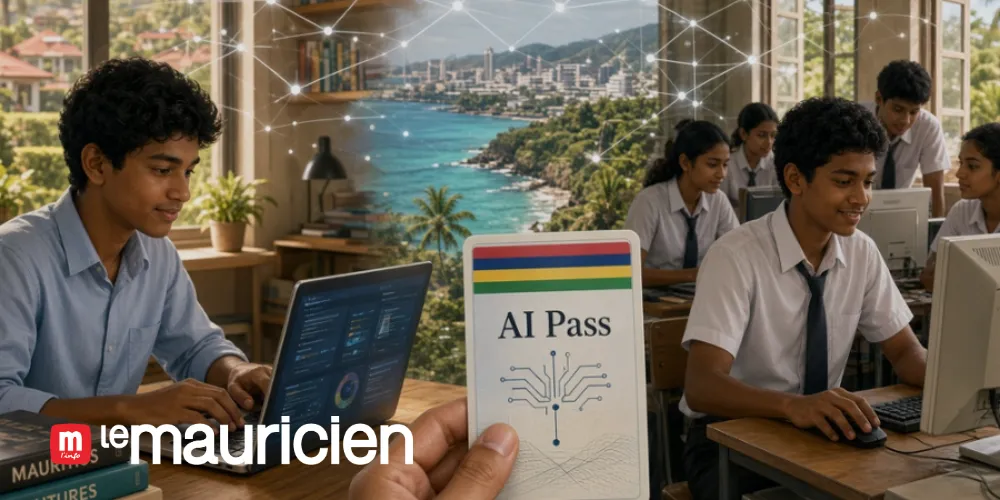
Two students – different AI opportunities
In Mauritius, education is free; however, a growing economic gap has always existed between those who have the means and those who do not. Ravi and Jean are two friends working on the same project but are in different economic family ecosystems.
Ravi, from a well-off family, has premium account access to Claude and ChatGPT. He uses it to learn and accelerate his understanding of the world. Jean, however, has access to this technology limited to a computer shared at school with ten other students and the free questions available on Claude and ChatGPT. Only one, due to economic barriers, can afford AI compute time.
This is the reality of the economics in Mauritius and many developing countries – equal access to the world’s most powerful technology. In Mauritius, the administration got it right. They thoughtfully ensured that mobile coverage is available to 99% of the population. As of 2025, 93 percent of secondary schools have internet for students – all funded by taxpayers. However, this is not enough – if you want an AI-savvy workforce, we can’t afford even eleven students sharing one computer and access to free-tier AI models.
In Seattle (more specifically Tahoma school district), my kids each have a laptop – compliments of funding from the State and Microsoft and Google. Also, they have access to premium Claude – compliments of mom’s and dad’s funding.
This gap between Seattle and Kigali, Dhaka and Antananarivo – it is even wider there. Solving this will put small and developing countries on the global map. Giving the rest of the world access to SAFE AI makes the world better and safer.
AI models get better every few months
On 1 September, Anthropic released Claude Fable 5.1. On 3 September, OpenAI released GPT-6 Astra. Better, newer models will come every two or three months. (Fun fact on the names: Anthropic names its models after literary and creative mediums, using the complexity of the art form to mirror the model’s intelligence. Haiku is fast and brief, Sonnet is balanced, Opus is a masterpiece, and Fable is an advanced narrative.)
Large language models, such as those from Anthropic and OpenAI, are trained on a huge pile of text and code. They give you superpowers. However, none of them live in Port Louis, Kigali, or Colombo. Tokens, which are the new economic barometer, are priced so the labs can recoup what the models cost to build. Fable is costly even by US standards ($10 per million tokens in and $50 per million tokens out – a million tokens is equivalent to having about ten novels processed – not so bad). This pricing will not be decided in the hallways of parliament in Port Louis, but in AI labs on the West Coast. One idea would be to have special prices for developing countries. OpenAI and Google already have such plans in Africa and Asia, and that enabled them to penetrate the market and help the world.
Anthropic got it right amongst other AI companies
Dario Amodei, one of the most followed CEOs and spokesperson of AI Safety – CEO of Anthropic – in a famous blog, says we are heading toward « a country of geniuses in a datacenter ». He also writes that if this technology helps rich countries while doing little for the rest, « we should view that as a terrible moral failure » – I can’t say it better – I first-hand saw how education can help one to have more access to opportunities. One of his goals is that the developing world, a few years after powerful AI arrives, should be healthier than the rich world is today. Coming from a developing country, I am 100% on board with this. Education is the definition of freedom and a better world.
Many industry giants make big statements; Anthropic backed its words with three principles.
- First: It gave teachers and clinics access first. In Rwanda, which just signed with Anthropic in February, 2,000 teachers got a year of Claude, and the health ministry got help on its plan to end cervical cancer. Anthropic and the Gates Foundation are putting $200 million in grants, Claude credits, and technical support into health and reading programs in Africa and India. This is progress – start with the people who teach and heal, in the countries that need it most. In Mauritius, the government and the private sector need to build the same relationship.
- Anthropic, whose mantra is safety first, ships power with strict rules (the whole model is based on a set of rules called the constitution, which draws on human documents like the Universal Declaration of Human Rights). The models Fable 5.1 and Mythos 5.1 are the same model. Fable is for all users, while Mythos is the version with fewer locks for cybersecurity and biology work, available only to trusted, approved groups – the analogy I have is: don’t give a gun to an unlicensed person.
- Anthropic (kudos to their strong engineering culture; you need to watch the videos on how they started) tells the truth when things go wrong. On Friday, 12 June 2026, the US government put export controls on Claude Fable 5. Because Anthropic couldn’t check every user’s nationality in real time, it switched the model off for everyone rather than break the law. It said so publicly, closed the security hole that triggered the order, and had the model back on 1 July. For nineteen days, the world held its breath. No dark room; they were transparent with the world and the press. The CEO, who has often said that democracies must lead in AI and that he believes in safe AI, walked the talk.
For small countries, this teaches an important lesson: you don’t control the AI model; the switch is very far away, and you are basically renting, so as a tenant you have to be careful.
How did the small state nation Singapore solve it?
Singapore has found a working solution that most small developing nations can follow. It had a trinity of policy changes:
- With government funding, it built its own apps on rented models, with failovers; more than half of Singapore’s 150K public officers use them regularly for writing and research. The state owns the door, rules, and data. Labs around the world own the engine.
- It builds its languages on open models to avoid dependence on a closed-weights model. Singapore’s SEA-LION models for Southeast Asian languages are trained on open-source models from Google, Alibaba, and Meta, then released to everyone. Singapore does not wait for the US to decide its destiny. Something Mauritius can embrace from a policy perspective.
- Singapore placed AI in schools with supervision (US school districts, New York among them, are heading the same way). Students experience AI at Primary 4 (4th Grade) and only with tools that the government vets, with supervision of a teacher who has completed a compulsory AI module.
Singapore is richer than Mauritius, Rwanda, or Sri Lanka. However, the policies and rulebook still apply – rent well but don’t overspend – control your destiny.
Three policies or decisions that will help small nations in the AI world
Mauritius, my hometown, moved faster than the world has noticed. In April, the government launched a national AI strategy and the FAIR guidelines, which stand for Fairness, Accountability, Inclusiveness and Integrity, and Responsibility. The recent budget of 2026 – the cohort of members of the current government are in tune on what is going on in the world of AI – will train 8K teachers, give 12K students AI learning tools, and train 25K Mauritians in AI. (Being in this domain for long, I took it for granted, but it is a new science and requires learning and a change of mind – being on the West Coast where it all started, many of us take it for granted – but it is a privilege to be AI trained, and the Mauritius government is short-circuiting the process.)
Mauritius Telecom (MT) – the national telecommunication giant – (led by my brilliant college friend Veemal Gungadin) is piloting mytGPT in ten schools, and the first pilot ran in Rodrigues with 70 Grade 12 students. Rodrigues went first, for once. I got a glimpse of the product when I toured their facilities while I was in Mauritius, and it blew my mind.
Year one – That was a really good year – good governance, right folks who understand the arena of AI and its domain. Year two – in Mauritius and in any developing country with a phone network and a school system.
First, an AI Pass for every student and teacher – a safe account with monthly credits, with agreements with the AI Labs (Anthropic or OpenAI – that conversation should start now – those companies are changing the world for the next 20 years and they are more than willing to help the next generation to onboard on the technology). Learn token economics and models – Cheap questions go to cheap models. Hard problems go to Fable or Astra.
Second, focus on getting open models and making them sovereign. Run it on machines the countries own. MT and the private sector have H200s. Homework, translation, first drafts stay within the island. The complicated workloads go to the Frontier models – rent. Also, you build a resilient engineering workforce who understand training/inference – think of the benefits and business opportunities this can lead to. Concepts that were in SF and Seattle now can be in Ebene and Port Louis – worth investing, and you will become the benchmark of the region.
Third, we need human guardrails written into laws about how the government uses or buys the technology. This will be akin to what Anthropic did with its own AI through a written constitution. Each decision touches people’s lives, regardless of their economic pedigree. Every system needs rigorous testing before it goes public. Our neighbor Seychelles did this with a new school framework in July – teachers keep final grades, certificates, and placements, while the AI does the grunt work of tutoring and checking.
Small countries – together – e pluribus unum
While small countries are spread across the Indian Ocean, Asia, and Africa, internet use runs at 87% in Seychelles, 36% in Comoros, and 20% in Madagascar. Sad state of the world: half of small island states don’t have any AI plan. Mauritius should lead them and make an AI program with them: buy together, test together. Build relationships with Anthropic and OpenAI when they are still labs, not behemoths.
The right choice
Our short history has shown us how our fathers used sugarcane, textiles, and offshore banking to move from poor to one of the richest countries in Africa. But you might be making sugar, clothes, and funneling money for others, but you can lose this market to external forces beyond your control.
We will never afford a country of geniuses in the data center, but we can rent a desk there on fair terms and keep our files locally. We can make sure Jean in Rodrigues and Ravi from Ebene have access to the same files and opportunities.
By Rik Kisnah