
By Satyendra Peerthum,
Historian, AGTF
&
Kiran Chuttoo-Jankee,
Researcher, AGTF
On 2nd November 2026, the Government of Mauritius and the Mauritian people are commemorating the 192nd anniversary of the arrival of the indentured labourers at the Aapravasi Ghat World Heritage Site. Between 1826 and 1910, an estimated total of 462,801 Indian and non-Indian indentured workers (1) reached the shores of Mauritius. Between January 1826 and December 1842, the importation of indentured labourers was a private initiative which was controlled and funded by the Franco-Mauritian, British, Free Coloured and Indian planters, traders, negociants, and landowners.
It is estimated that 2251 Indian and Chinese indentured labourers (2) who came to Mauritian shores between January 1826 and July 1834, worked on individual and group indenture contracts of five years mostly on the sugar estates, and some in Port Louis. It is interesting to note that this represents more than half of the total number of contractual workers who were introduced in Réunion Island between the late 1820s and early 1830s.
The Case-Study of Immigrant Mahamod
or Mohameth
According to the Mahatma Gandhi Indian Immigration Archives and the Mauritius National Archives records, the first Indian immigrant who arrived as an indentured worker under a labour contract was Immigrant Mahamod or Mohameth. He arrived on 23rd January 1826 on board the Elizabeth from Calcutta, with his two sons Ali and Hamad. Mahamod was 45 years old and a Bengali Muslim from Birali, a village on the outskirts of the city of Calcutta. He was recruited by Captain Gaston to work as the servant of Mr. Oliver, one of the British managers who worked for Gaillardon’s Company at Pointe aux Piments Estate in the north west of Mauritius.
By 1836, Mahamod was working on Vale Sugar Estate as head servant in Captain West’s household. In 1839, he purchased three arpents of land near the present day village of Grand Bay and became a small cultivator. A few years later, in 1846 at the age of 65, he bought a second plot of land of five arpents. Shortly after, he left the employment of Captain West and devoted his full time to planting and selling garden produce and rearing livestock together with his two sons. He also employed several Old Immigrants. He became a small proprietor and furnished garden and meat produce to the Vale Sugar Estate and the emerging village of Grand Bay.
In 1856, Mahamod, his two sons, and five grandsons bought 31 arpents of land or a small estate close to the Vale Sugar Estate for some 1250 piastres or six dollars and Captain West acted as guarantor for their purchase. Between the mid-1850s and mid-1870s, Mahamod and his family became an important Indian and Indo-Mauritian family of small planters and proprietors in Pamplemousses District.
In 1876, after a long and productive life as a former head servant, landowner, and small planter, he passed away at the age of 95 on his small estate near Vale Sugar Estate but had lived to see his great grandchildren. Mahamod’s obituary was written by Captain West, with whom he had shared a forty-five year friendship, in Le Mauricien newspaper. It was an extremely rare occurrence during the Age of Indenture in Mauritius for a prominent British planter to write an obituary in honour of a former indentured worker.
These pioneers formed part of a constant trickle of Indian indentured workers coming to Mauritius prior to 2nd November 1834 and the ensuing massive introduction of contractual labourers. Referring to this early period of the history of indentured labour in this small Indian Ocean island, Vijaya Teelock emphasizes: “Uninterruptedly, the Indian contractual labourers were introduced in Mauritius in small groups at the requests of individual local planters.”
The Early Labour Experiment and the Articles of Agreement
Between January 1826 and July 1834, these early Indian and some Chinese contractual workers were brought to work mainly as domestics, babysitters, semi-skilled and skilled workers, for two to four years under the “Articles of Agreement”. They were mainly from Calcutta, Bombay, Pondicherry, Tranquebar, Madras, Singapore, and Penang. It was only in 1829 that some of the planters made a serious attempt to experiment with the first large-scale importation of indentured workers.
Between June and October 1829, an estimated 802 Indian and 398 Chinese indentured labourers were introduced into Mauritius from Indian Ocean port cities such as Madras, Calcutta and Singapore. Gaillardon, Thompson & Company played a key role in their importation. In October 1829, John Finiss, the Chief Commissary of Police, mentioned to Colonel Barry, Chief Secretary to Government in Port Louis, that: “I think it my duty to state these circumstances at the outset that if the experiment succeeds, further importations will no doubt take place”.
As early as 1829, local colonial officials, such as the colony’s main law enforcement officer, were already referring to the importation of hundreds of indentured labourers to work on the island’s sugar estates, as “an experiment” which was being carried out by the Mauritian planters. However, within a few weeks, this labour experiment proved to be a dismal failure, as some of the Franco-Mauritian sugar estate owners and their subordinates mistreated the indentured workers.
In addition, they either paid their wages late or did not pay them at all and failed to fulfill the other contractual obligations to their workers. As a result, the Indian and Chinese indentured workers refused to work and deserted the sugar estates. They were arrested as vagrants and eventually resorted to petty crimes. This proved to be a source of major concern for the local British colonial authorities and the police force. By the end of 1829 and early 1830, the British colonial authorities gradually repatriated the majority of the indentured workers to Madras, Calcutta and Singapore.
During the late 1820s and first half of the 1830s, quite a number of indentured workers were recruited on individual contracts, as the experiences of Peerkhan and Bactuon depict. In 1828, Peerkhan, a widower, arrived in Mauritius from Calcutta with his three sons who were in their twenties. He was 50 years old and engaged to work as a blacksmith for five years for Mr. Sampson on Belle Mare Sugar Estate in Flacq. Peerkhan was a Bengali Muslim born in 1778 in the town of Purohli. He left his employer in the late 1840s when he became a small landowner. He earned his living as gardener and later as a sugar cane cultivator. He passed away in the village of Poste de Flacq in 1872 at the advanced age of 94.
The indentured labour system became state-controlled and -sponsored in January 1843 and lasted until August 1910. The post of Protector of Immigrants and an Immigration Department were established in Port Louis to closely regulate and monitor the entire system in Mauritius.
(1) Estimated from Mahatma Gandhi Institute Indian Immigration Archives (MGIIIA), PE 1 to PE 161, Indentured Immigrant Ship Arrival Registers for 1826 to 1910; Mauritius National Archives (MNA), Z2D Series Volumes 1 to 188, Free Passengers and other Passenger Ship Arrival Registers for 1826 to 1911; Research for this article was undertaken in 2025 at the National Archives Department and the MGI Indian Immigration Archives.
(2) Estimated from MNA, Z2D Volumes 1 to 6, Free Passengers and other Passenger Ship Arrival Registers for 1826 to 1834; MGIIIA/PE 1, PE 2, & PE 4, Indentured Immigrant Ship Arrival Registers for 1826 to 1842.
…
Fig 1.
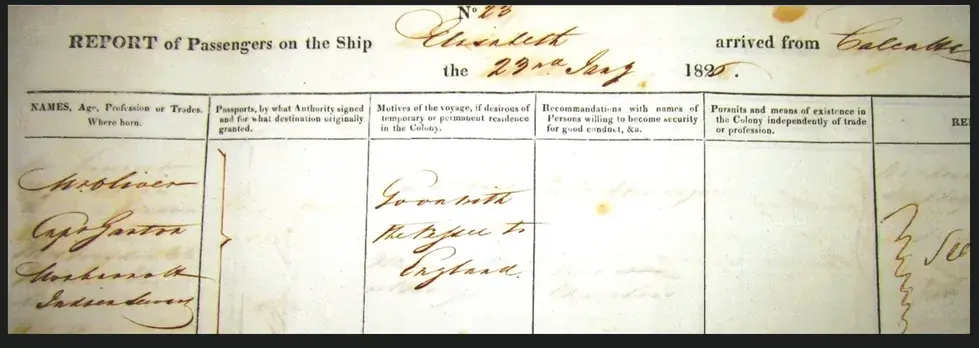 The Ship Register showing the arrival of Immigrant Mohameth in the company of Captain Gaston on 23rd January 1826 (Z2D Series, National Archives Department (NAD)
Fig 2.
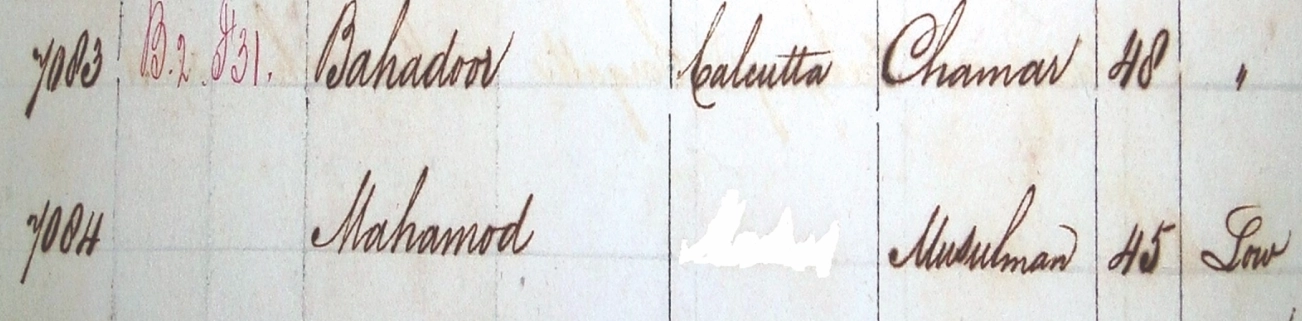
Immigrant Mahamod registered himself as an Old Immigrant at the
Immigration Depot or the present day Aapravasi Ghat World Heritage Site
in September 1847 and was provided with the number 7084
(PE Series, MGI Indian Immigration Archives (MGIIIA)/
(Immigrant Name and Number reproduced courtesy of A. Zafar Mahamod)
Fig 3.
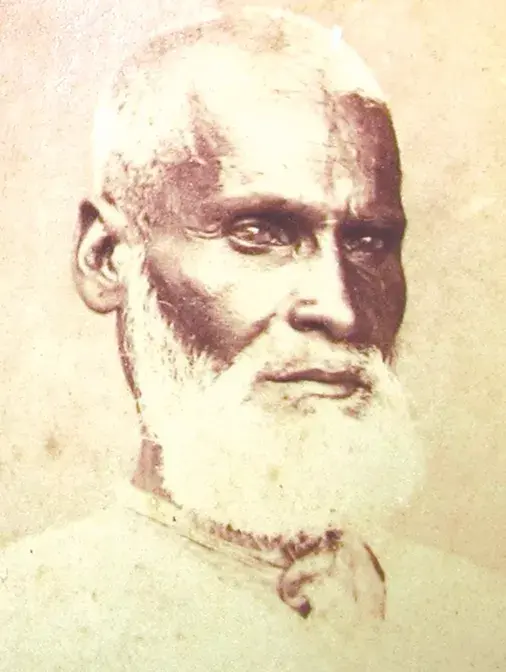
Immigrant Mahamod or Mahometh was photographed at the age of 87 in December 1867
at the Immigration Depot when he was intercepted by the local colonial police
because he did not have his immigrant papers on his person
(PG Series, MGIIIA)
Fig 4.
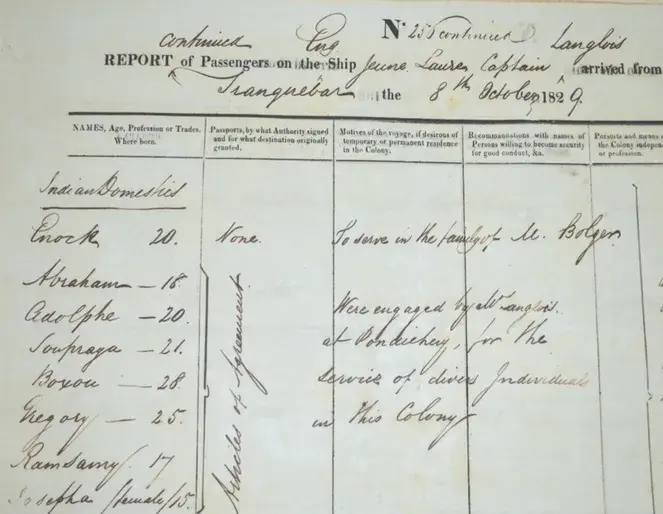
Enock, Abraham, and several Indian workers arrived in Mauritius from Pondicherry
in October 1829 for 4 years to work under the Articles of Agreement for Mr. Langlois, a Franco-Mauritian Planter. They clearly “were engaged by Mr. Langlois at Pondicherry, for the service of divers individuals in this colony”. (Z2D Series, NAD)
Fig 5.
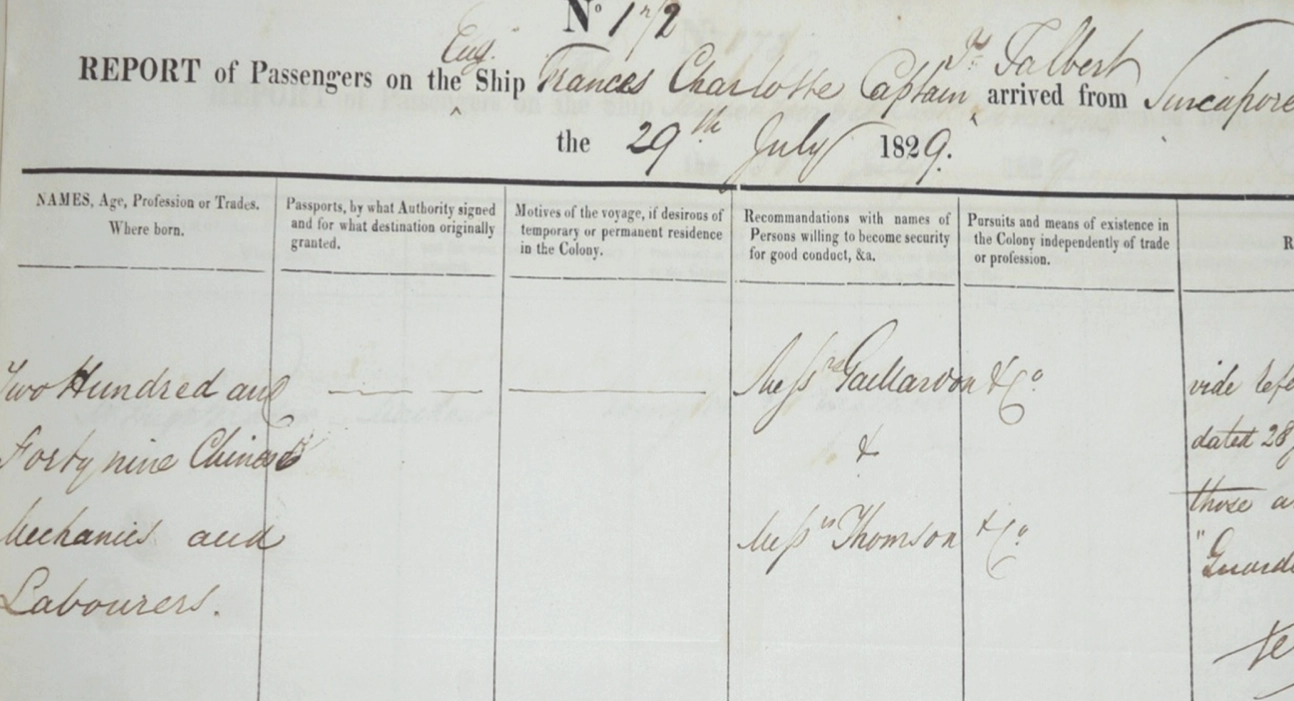 In 1829, 249 of the 398 Chinese indentured mechanics and labourers were
brought from Singapore by Mr. Gaillardon, Thompson & Company to work
on Mauritian Sugar Estates (Z2D Series, NAD)
Fig 6.
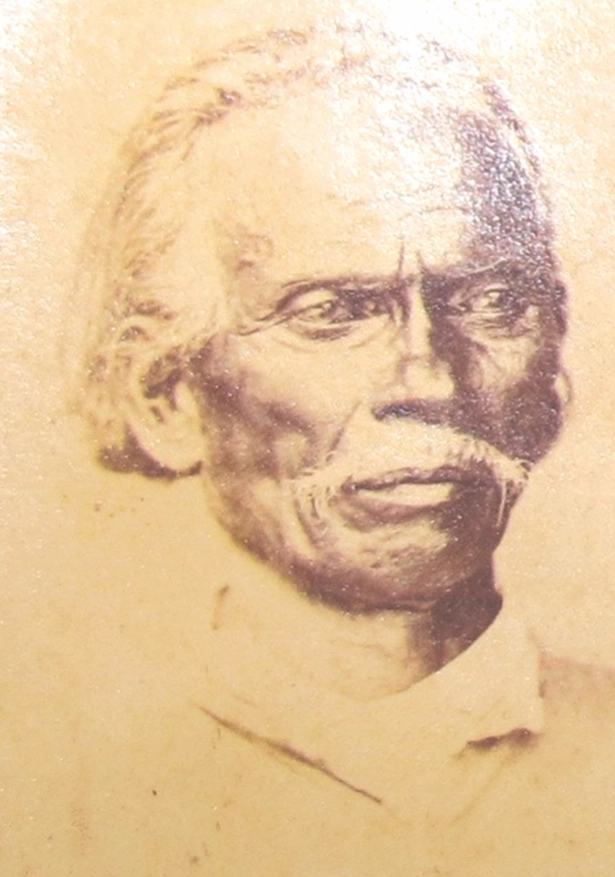 Immigrant Peerkhan was photographed
at the Immigration Depot in 1868 at the age of 90 (PG Series, MGIIIA)
