
Claim for Reparation
On the 23rd of August, we commemorate the “International Day for the Remembrance of the Slave Trade and its Abolition”
Now, the time has come for justice and reparation. On the 25th of March 2026 the United Nations General Assembly, officially declared slavery as “The Gravest Crime Against Humanity”. The resolution was passed with 123 votes in favour, 52 abstentions and 3 votes against (United States, Brazil, Argentina).
The case is made, no more debate: “For 300 years, did we have a legal case for reparatory justice? The answer now is yes. The case has been made. There’s nothing more to discuss whether there’s a case or not. The question now is implementation and demand. That’s where we are now at this moment” – Professor Sir Hilary Beckles.
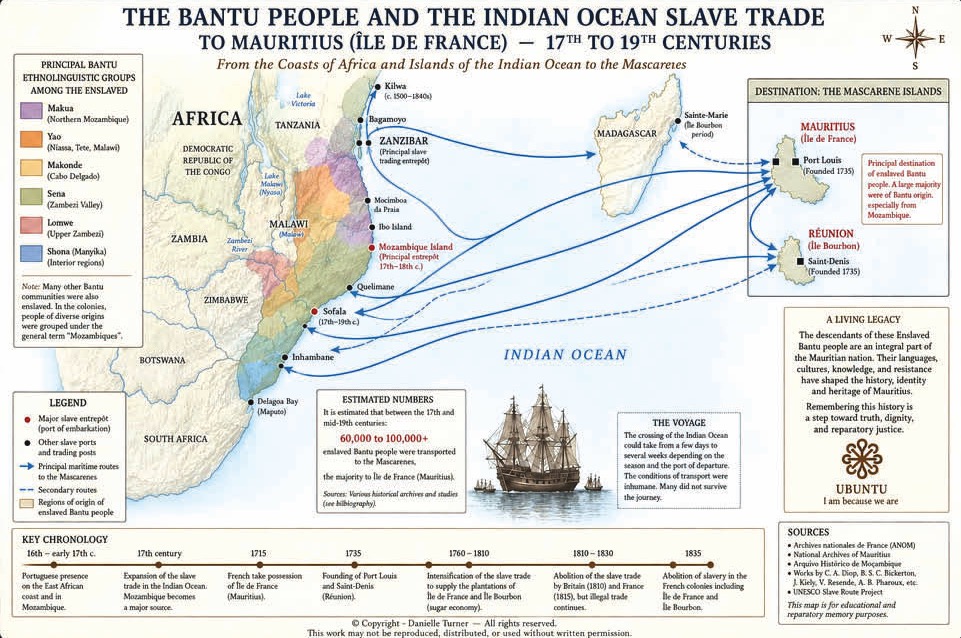
The enslaved Bantu People are the ancestors of nearly most of those forming part of the creole community of the Republic of Mauritius. The Bantu enslaved have been systematically abducted from their lawful homelands in Central, Eastern and Southern Africa as well as Madagascar. During enslavement of the displaced Bantu population on the island of Mauritius enslaved Bantu women gave birth to firsts Bantu-Mauritians. A new Bantu Ethnic was born known as creole.
This extraction, deportation and displacement from their mainland was executed via state-sponsored, commercial joint ventures managed by European colonial powers. Those who were prominently responsible for such include: Great-Britain, France and their partners in crime, the Roman Catholic Church and the Church of England. In modern days these perpetrated crimes are named: terrorism.
In Mauritius, this act of terrorism reached a highly institutionalised scale. Subjected to forced Oceanic transit, already enslaved, those Bantu people were upon arrival on the island placed in a permanent, hereditary status of chattel slavery. By such doings slave traffickers fuelled the colonial sugar economy and extended extra-territorial control for political power and economic wealth.
From capture in their homeland to Mauritius, these Bantu people were completely excised from their native territories. Liquidated of their political sovereignty, their socio-cultural infrastructure was completely destroyed by institutionalised white supremacy ideology.
On the 1st February 1835, when Great-Britain enforced the Slavery Abolition Act, it refused to compensate the 66,343 registered enslaved. Instead, the British government paid out a colossal sum of 2,112,632 pound sterling directly to the white planters, “absentee” slave owners and the clergy. They formally claimed reparations and filled compensation claims for the loss of the enslaved persons they legally owned following the abolition Act of 28th August 1833.
Then came 4 years of manumission where the enslaved were kept in nearly the same situation as during slavery. After the 4 years they did not receive any pecuniary gain, acquired no rights either economic, social or political.
The so-called freed slaves left the plantations with neither the resources nor the rights necessary to enjoy genuine freedom. Unlike the slave owners, who received financial compensation for the loss of what the law had regarded as their property, their ‘meuble’. The emancipated men, women and children received no compensation for generations of forced labour, suffering and dispossession.
They were granted neither land, housing, capital and nor meaningful assistance to establish independent lives. They left slavery without economic security, civil and political rights. Their sole inheritance was the determination to survive and rebuild their lives in a society that continued to be shaped by the inequalities and structures created by slavery.
This Land Is Africa
The formerly enslaved Bantu people, today largely identified as the creole community in Mauritius, were living on this part of Africa (Mauritius island) where they have been forcibly transported. Victims of human trafficking, mass deportation, displacement and playing a central role in building the colony yet they continued to be treated as an underclass, deprived of citizenship.
Not settlers, not immigrants, not colonisers just displaced and still enslaved through a colonial structure rooted in racism and institutional discrimination, economic apartheid and social exclusion, they are still waiting for justice. Their descents are still enduring this colonial legacy.
Reparation
Since 2005 the UN General Assembly has adopted through Resolution 60/147 the Principle of Non-Expiration (principle iv). This resolution dictates that statutes of limitations shall not apply to gross violations of international human rights law that constitute crimes under international law.
This resolution targets “gross violations”, which encompass systemic mass deportation, human trafficking, armed conflict, arbitrary dispossession, and hereditary subjugation, which clearly describe the operational realities of the slave trade of which our Bantu ancestors have been victims – and their descendants are still suffering ongoing damages.
Resolution 60/147 stipulates under (principle: 19, 20,21,22,23) the needs for: Restitution, Compensation, Rehabilitation, Satisfaction, Non-Repetition.
Colonisers and Slave Traffickers Cannot Claim Ignorance
The colonial authorities and institutions cannot plead ignorance of the legal principles and moral standards that were applicable at that time. They consciously chose to disregard those principles in pursuit of economic gain, political domination, and, above all, the systematic and systemic dehumanisation of enslaved people. Their actions were not the product of ignorance, but deliberate choices.
The French and British colonisers violated principles of international law that were already recognised during the era of the slave trade. So, the principle of non-retroactivity cannot properly be invoked in the case of Great-Britain, France and their partners. It is both inappropriate and inapplicable to the legal and historical issues of the slave trade and its ongoing damages.
Early legal jurisprudence established that sovereign political communities possessed inherent territorial rights. British and French state-backed corporations violated early jus gentium by executing armed incursions, instigating proxy wars, and systematically kidnapping populations from sovereign African polities without a lawful declaration of war. Which in short is a clear violation of the Customary Law of Nations.
Another crime which was under early customary law, is the unauthorised seizure of persons on the high seas, this was already classified as piracy – a crime considered hostis humani generis (an enemy of all kind). While both empires granted domestic monopolies to slave traders, their maritime operations were universally banned under general customary maritime law.
Another foundational maxim of Roman law which encompassed European customary law is the doctrine of unjust enrichment (Abus de Droit). This doctrine states that no party should be unjustly enriched at the expense of another through an unlawful or abusive act. By this tort of systematically extracting wealth through uncompensated labour and ancestral dispossession, both empires built their domestic economies upon an ongoing, legally recognized tort of unjust enrichment.
These actions constituted a Per Se Violation of the jus Cogens Prohibition: Against Crimes Against Humanity. Thus, the principle of non-retroactivity is inapplicable. While statutory treaties generally do not apply retroactively, jus cogens reflect universal customary laws that have bound humanity since antiquity and this despite domestic colonial laws at that time.
The violation of jus cogens creates obligations erga omnes. Obligations owed to the international community as a whole. Which means that any international body or victim coalition has the legal standing to demand redress, and no state can recognize the legal validity of a situation created by a jus cogens breach.
These tortious crimes have remained unremedied and are still causing active, compounding damages to the descendants, the today creole community. This ongoing harm prevents the tolling of any statute of limitations.
An Ubuntu Obligation
It is therefore legitimate to seek reparatory justice for the descendants of the enslaved Bantu people of Mauritius. Beyond its legal and historical foundations, this claim embodies a moral duty and a need for restorative justice – an Ubuntu obligation – to recognise the past, foster truth, restore dignity, and to build a more just future.

Danielle Turner
For KRI (Kreol Research Institute)