

Ashveen Kutowaroo FCG PMP® LLM MSc
Chief Editor, Aryodaye, the mouthpiece of Arya Sabha, Mauritius & Founder and Policy Advocate, JP Narayan Centre for Sustainable Development and World Peace
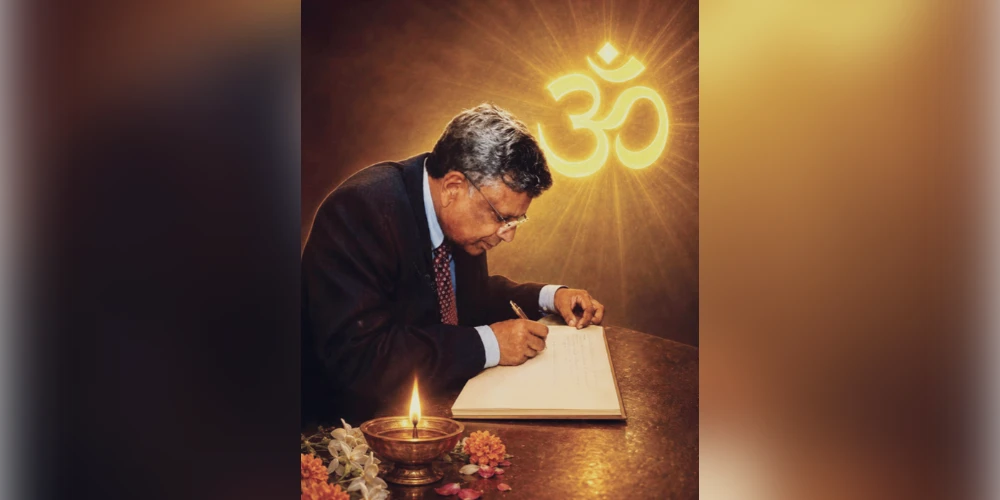
The passing of Shri Mithileswar Banymandhub, affectionately known as Mithyl, on 14 June 2026 has deprived Mauritius of one of its most dedicated men of letters. Teacher, lecturer, editor, poet, columnist, proof-reader and lifelong student of knowledge, he belonged to a generation of intellectuals who believed that education was not merely a profession but a calling.
For decades, his pen enriched newspapers, magazines and journals across Mauritius and beyond. His articles informed, his poems inspired and his command of the English language elevated the quality of every publication with which he was associated. Yet despite his accomplishments, he remained a humble and unassuming figure whose greatest satisfaction seemed to come from sharing knowledge and nurturing the written word.
Born on 15 July 1951, Mithileswar Banymandhub displayed an early love for learning and language. After completing his Higher School Certificate at the College du Saint Esprit, he pursued higher studies in India, a journey that would shape his intellectual development and future career.
He joined Hansraj College at the University of Delhi, one of India’s most respected institutions of higher learning. There, he immersed himself in the study of English literature and language, eventually obtaining a Master’s Degree in English. His passion for education led him to further studies at the Central Institute of Education in Delhi, where he earned a Bachelor of Education degree.
Those years in India were formative. They exposed him to a rich literary tradition, broadened his worldview and deepened his appreciation of language as a tool for understanding both society and the human condition.
Upon returning to Mauritius, he joined the Mahatma Gandhi Institute as an Education Officer. It was the beginning of a distinguished career in education that would span several decades. His competence, dedication and scholarly approach soon earned him promotions to Lecturer and subsequently Senior Lecturer.
Generations of students encountered him in lecture halls where he taught English Literature at degree level. Many would remember not only his academic rigour but also his ability to make literature accessible and meaningful. He possessed that rare quality found in exceptional educators: the ability to inspire curiosity.
To teach literature effectively requires more than knowledge of texts. It requires an understanding of people, cultures and ideas. By all accounts, Mr Banymandhub possessed these qualities in abundance.
His love for literature did not end in the classroom.
Outside his professional duties, he became one of Mauritius’ most prolific contributors to newspapers and magazines. His interests were remarkably diverse. He wrote with equal ease about literature, society, politics, culture, religion and current affairs.
Readers of Forum in Le Mauricien became familiar with his thoughtful contributions on a wide range of subjects. One week he might analyse developments in politics. The next, he might explore the influence of Bollywood on society or discuss the challenges facing young people in modern Mauritius. His writing reflected an enquiring mind that refused to be confined to a single field of interest.
Indeed, one of the most remarkable aspects of his personality was his intellectual curiosity.
Mr Banymandhub was a voracious reader. Books were not merely possessions for him; they were companions. He read extensively and widely, exploring subjects that ranged far beyond his professional specialisation. Whether the topic was history, literature, philosophy, politics, religion or contemporary affairs, he approached it with enthusiasm and a genuine desire to understand.
This habit of lifelong learning enriched his writing. His articles were informed without being intimidating, scholarly without being inaccessible. He had mastered the difficult art of communicating complex ideas in simple language.
That gift became particularly evident in his long association with Aryodaye.
For many years, he contributed articles, essays and poems to the newspaper. Indeed, it would be difficult to find an issue of Aryodaye that did not bear the imprint of his intellect and dedication. His writings became a familiar and much-appreciated feature of the publication.
Readers looked forward to his contributions because they knew they would encounter clarity, substance and thoughtful reflection. His command of English was admirable, yet he never wrote to impress. Instead, he wrote to communicate.
This perhaps explains why his work resonated with such a wide audience. He understood that the purpose of language is not to demonstrate superiority but to build understanding.
His contribution to Aryodaye was all the more remarkable because he was not an Arya Samajist in the strict organisational sense. Yet his affection for the newspaper and his respect for its mission were evident in the consistency and quality of his contributions.
He demonstrated through his actions that service transcends labels and affiliations. One need not belong formally to an organisation to contribute meaningfully to its growth and success.
His admiration for the ideals and personalities associated with the Arya Samaj movement found expression in several of his writings. He wrote poems dedicated to Maharshi Swami Dayanand Saraswati, the founder of the Arya Samaj, and reflected on themes drawn from Hindu festivals and cultural traditions.
Among his memorable works was a poem entitled The Harbinger of Light, which captured the spirit of hope, renewal and enlightenment associated with the festival of Deepavali.
His literary contributions extended beyond journalism and poetry. He was also an accomplished editor who assisted in the publication of numerous books. One of his notable editorial achievements was the 1998 publication of the Mahatma Gandhi Institute entitled Major Figures of the Mauritius Arya Samaj. The work remains an important contribution to the documentation of the history and personalities associated with the Arya Samaj movement in Mauritius.
Such projects require patience, precision and attention to detail, qualities that defined Mr Banymandhub’s professional life.
As one who recently assumed responsibility for the English Section of Aryodaye, I experienced a profound appreciation of his work, albeit indirectly.
Sadly, by the time I became Chief Editor, Mr Banymandhub had already been taken in medical care. I never had the privilege of working alongside him, discussing articles with him or learning from his experience firsthand.
Yet I came to know him through his work.
Following his illness, I inherited a portion of the responsibilities that he had faithfully discharged over many years. It was then that I began to understand the scale of his commitment.
Producing quality content week after week is no easy task. It demands discipline, perseverance and sacrifice. To sustain such effort over decades is an extraordinary achievement.
His absence revealed the magnitude of his contribution.
Beyond his professional and literary accomplishments, Mr Banymandhub experienced both joy and sorrow in his personal life. A few years ago, he suffered the loss of his beloved wife, Mrs Menka (Roshni) Banymandhub, née Bacha, herself a distinguished educator who served as Acting Deputy Rector at the Mahatma Gandhi Institute in Moka.
Despite this profound loss, he continued to pursue his intellectual interests and maintain his commitment to writing and education.
Today, he leaves behind two daughters, Dr. Sushila (wife of Dr Sachin Ramdhany) and Mrs Swapna, (wife of Mr. Nirmal Groodoyal), both accomplished professionals in their respective fields, who undoubtedly carry forward the values of learning, discipline and perseverance that characterised their parents’ lives.
As we reflect upon the life of Shri Mithileswar Banymandhub, we are reminded that true influence is not always measured by public recognition or prominence. Sometimes it is measured by the thousands of minds one helps to shape, the countless readers one inspires and the institutions one strengthens through quiet, consistent service.
His writings remain. His ideas endure. His example continues to inspire.
Future readers who encounter his articles and poems will discover a writer who combined scholarship with simplicity, intellect with humility and knowledge with humanity.
That is perhaps the finest legacy any writer can leave behind.
We pray that the Almighty grants Sadgati to the departed soul of Shri Mithileswar “Mithyl” Banymandhub and strength to his family, friends, former students and colleagues during this time of loss.
Om Shanti.
