

December 1
World AIDS day, designed on 1 December every year since 1988 , is an international day dedicated to raising awareness of the AIDS pandemic caused by the spread of HIV infection and mourning those who have died of the disease.
To mark the pivotal impact communities have had in shaping the HIV response, as well as global health at large, the theme of World AIDS Day 2023 is ‘Let communities lead’.

World AIDS Day is an opportunity to reflect on the progress made to date, raise awareness about the challenges that remain to achieve the goals of ending AIDS by 2030 and mobilize all stakeholders to jointly redouble efforts to ensure the success of the HIV response.
The latest statistics on HIV around the world from UNAIDS Exit Disclaimer include:
Number of People with HIV—There were approximately 39 million people across the globe with HIV in 2022. Of these, 37.5 million were adults, and 1.5 million were children (<15 years old). In addition, 53% were women and girls.
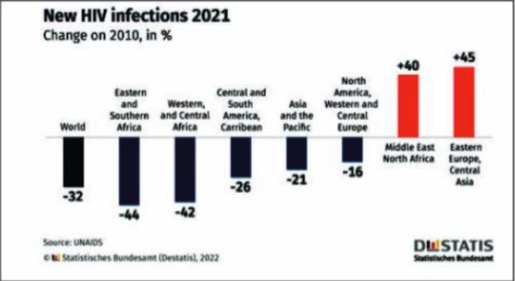
New HIV Infections—An estimated 1.3 million individuals worldwide acquired HIV in 2022, marking a 38% decline in new HIV infections since 2010 and 59% since the peak in 1995.
According to UNAIDS estimates of 2021 there is an increase of 1.4 % HIV patients in Mauritius from 2009 to 2019.
According to the Ministry of Health and wellness Mauritius, Statistics on HIV/AIDS (as at end of December 2022) from January to December 2022, a total of 391 new cases of HIV/AIDS were registered among the Mauritian population by the Virology Laboratory Services of the Ministry of Health and Wellness. The monthly average of new cases decreased from 46 in the period 2006 – 2010 to 26 in the period 2011 – 2016. However, for 2017 – 2019, it went up to 31. In the year 2020 and 2021, the monthly average was 27 equally. In 2022, it has increased to 33.
World AIDS Day brings together people from around the world to raise awareness about HIV/AIDS and demonstrate international solidarity in the face of the pandemic
The day is an opportunity for public and private partners to spread awareness about the status of the pandemic and encourage progress in HIV/AIDS prevention, treatment and care around the world. It has become one of the most widely recognized international health days and a key opportunity to raise awareness, commemorate those who have died, and celebrate victories such as increased access to treatment and prevention services
Human immunodeficiency virus (HIV) infected individuals frequently suffer from anxiety and depression. Depression has been associated with rapid decline in CD4 counts and worsened treatment outcomes in HIV-infected patients. Yoga has been used to reduce psychopathology and improve immunity.
Human immunodeficiency virus (HIV) infection is a communicable disease leading to significant morbidity, mortality, and poor quality of life. Approximately, 2.5 million individuals were found to be infected with HIV-1 infection in the 2009 survey. Though Anti-Retroviral Therapy (ART) has significantly increased the life span and treatment outcome in HIV-infected patients, social stigma, depression, substance abuse, and wrong cultural beliefs significantly impair their quality of life. Mental disorders such as major depressive disorder, generalized anxiety, and agoraphobia are commonly found in patients with HIV. Out of all these, depression is the most prevalent comorbid mental disorder with a prevalence of 22–38% among HIV-infected patients. Unemployment, lack of health insurance, low CD4+ cell counts, not having a partner, and poor quality of social support are significant contributors to depression in HIV-infected patients. Depression is found to be associated with poor adherence to ART, and also influences CD4 counts and viral loads (VLs) negatively. Antidepressant medications are helpful, but they are not free from side effects.
Complementary and alternative medicine is becoming popular as rehabilitation measures in patients living with HIV/AIDS. Yoga is the most commonly used mind–body intervention.It is cost-effective and easy to implement and offers benefit for emotional, psychological, and physical health .Yoga encompasses asanas (Yogic postures), pranayama (Yogic breathing practices), yoga-based relaxation techniques, and meditation.
Many studies demonstrated the broad positive impact of yoga on health and many disease conditions.Yoga can augment current treatment modalities of HIV infection. Yoga helps in many psychological conditions such as anxiety, depression, and schizophrenia. It improves overall well-being and quality of life in many chronic medical illnesses. Earlier studies reported the potential role of yoga in resisting the impairment of cellular immunity. In a study in healthy volunteers, Yoganidra (a yogic relaxation technique) practice given for 30 min daily for 6 months showed a significant reduction in erythrocyte sedimentation rate than the control group. In another study, yoga practice improved natural killer cell activity in early breast cancer patients. In a randomized control trial on pulmonary tuberculosis patients, 2 months of yoga practice helped in reducing the infection.
Yoga is proven to be safe and effective in reducing depression and anxiety. In a study, yoga helped reduction of blood pressure in pre-hypertensive HIV-1 infected subjects. There is a need for exploration of this area with a better design. Therefore, the following Yogic techniques are important to boost the immune system of the infected person and also reducing the depression.
Breathing Practices : Nadishudhi Pranayama, Brahmari Pranayama and Sheetali , Sectional breathing
Asanas : Tadasana, Trikonasana, Ardha chakrasana, Padahastasana, Vajrasana, Badhakonasana, Surya namaskar, Sethubhandasana, Dhanurasana.
Meditation: Cyclic Meditation, Yoganidra, Omkara Dhyana.
Somya MD
