

Satyendra Peerthum
Historian, Writer, and Lecturer
&
Stefan Gua
Member of
Rezistans ek
Alternativ &
Ecosocialist Activist
UNESCO’s International Day for the Remembrance of the Slave Trade and its Abolition was commemorated for the first time on 23rd August 1998 in Haiti, therefore this year marks the 28th year of its first commemoration. A year later, in 1999, it was observed on the island of Goree, Senegal, where a major World Heritage Site intimately associated with the slave trade and slavery is located. In our country, it was only in 2005, that the Government of Mauritius started, not only commemorating, but also understanding the historical importance of this particular international day.
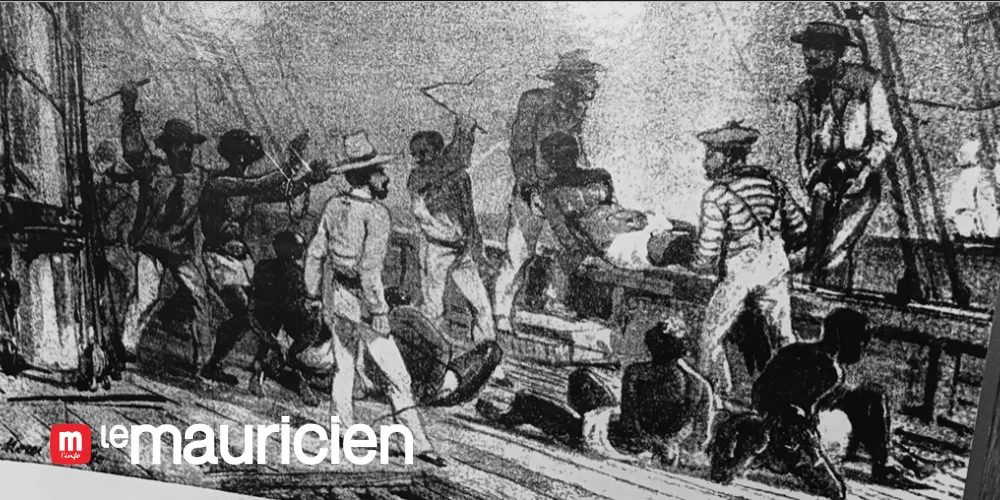
Revolts on Slave Ships on the High Seas
The saga of our enslaved ancestors’ quest for freedom started with their resistance to their capture by Europeans, Arabs, and their local intermediaries in their native lands. Many captives perished during the razzias or raids. Attempts at evasions from depots where they were kept awaiting delivery to the slave traders and revolts on board slave ships were a common occurrence. These revolts were rarely successful as all odds were stacked against the captives in chains. The crewmembers of the slave ships were numerous and they were very heavily armed. Yet these captives dared to risk their lives by revolting because of their determination to avoid their enslavement.
On July 29th, 1783, while the crew of a French slave ship was busy buying captives at Guilwa (or Kilwa), in Mozambique, the two hundred and forty-three enslaved people already on board the ‘Pintade’ rose in revolt around 11 o’clock in the morning. The Sr. Langlois, the second in command to the Captain Antoine Boudin K/Ozet, was seriously wounded in the head and his black domestic servant, Anasthasy, a creole from Bourbon Island, was killed.
The rebels threw a white sailor named Jean Baptiste Fremier into the sea and a few of the other persons on board were seriously wounded. In the confusion, a great number of the insurgents made a successful escape in a canoe of the ship, which was later, found on the coast. In order to save the lives of the crewmembers and to protect the property of the shipowner, many of the insurgents remaining on board were put to death.
In May 1780, a Portuguese brig commanded by Captain Joseph Caetan Rodrigues was already on the high seas on its way to Ile de France with a cargo of two hundred and thirty-seven captives in its hold. At half past ten in the morning of the 14th, when all the members of the crew were busy with different maneuvers and chores, the enslaved rose in revolt after a signal was given by one of them named Bororo, who seized, by the throat, Le Bel, the ship’s pilot on duty on the quarter deck.
Armed with instruments found on deck the insurgents rushed to the back of the ship and started attacking. Le Bel broke loose of the grip of Bororo, jumped into his cabin where he got hold of his sword, with which he pierced and killed many of the rebels. In despair, many of the enslaved men and women threw themselves into the sea. With the superiority of his weapon, Le Bel foiled the revolt. The remaining captives sought refuge in the hold and Le Bel had the hatch closed behind them. After getting twenty-three pair of irons ready, he summoned them to the deck. The strongest among them were put in iron and the others were tied with ropes.
When he asked who was the ringleader, they all pointed in the direction of Bororo, who readily admitted his guilt, defiantly declaring that he had missed his coup (or his chance), but another time, he would not miss, as he would take all his precautions. After examining the weakness of the crew in those circumstances against two hundred strong men from whom anything could be expected while Bororo was alive and who had their trust as he passed himself for a sorcerer, the decision was taken by the leading members of the ship’s crew to execute the leader of the revolt. He was shot in the presence of the other captives and his body was cast into the sea. Thirty-seven insurgents had lost their lives in this revolt.
The French slave ship the ‘Navigateur’ commanded by Captain Emmanuel le Joliff was on its way to Isle de France with a shipload of captives, when at eight o’clock on the morning of 2nd November, 1803, a revolt by the enslaved men broke out. The officers and other crew members immediately armed themselves and opposed the enterprise of the insurgents. Once calm was restored a head count showed that four captives were missing. They had thrown themselves into the sea though there could be no hope of swimming back to the coast. The document specifically mentions that the revolt occurred when the ship was already on the high seas.
Obviously these were not the only revolts on board ships carrying their captives to their destination in servitude. There are most likely other such documents scattered in various archives centers recording the brave actions and the desperation of our enslaved ancestors, a testimony to their undying love of freedom. Here we run into the usual difficulty familiar to social historians; not all the acts of the enslaved were systematically recorded. Besides, not all log book of ships that brought the tens of thousands of captives to the shores of Mauritius have been preserved. We have ground to suspect that some criminal hands may have destroyed some of the documents.
Auto-destruction was another form of resistance against their enslavement during the journey from East Africa and Madagascar to Mauritius. Desperate to avoid their enslavement, they used to throw themselves overboard. They preferred death, the supreme sacrifice, to a life in slavery not only for themselves but also for their future offsprings.
Maritime Maroonage and Salt-water Maroons
In the Caribbean islands, some enslaved people used different means to escape from the island where they were held captive. They escaped in small homemade crafts, by boarding foreign vessels, and by escaping on pirate ships to another island where they could find freedom. This type of maroonage which is known as maritime maroonage and the escaped men and women, as salt-water maroons did exist in colonial Mauritius. But, unlike in the Caribbean, in Mauritius, most of them didn’t escape to other islands but tried to return to their homeland. Maroons in T’Eylandt Mauritius are known to have left the island on board foreign vessels because in an annex to his letter of 26th October, 1706, the Dutch governor reported such cases. These salt-water maroons most likely went back to their native lands.
Attempts by the enslaved men and women from Madagascar and India to go back to their land of birth, specially during French rule, were not rare. Most of them failed to reach their cherished destination as they were swallowed by the treacherous waves of the Indian Ocean. But some of them did succeed in rowing their frail embarkation safely to port which was sometimes a 900-mile odyssey. They, so to say, rode the crest of the waves to freedom, aided by the winds that generally blew in that direction.
It was not always in stolen boats that they attempted these long journeys usually to Madagascar and to the coast of East Africa. They also made a large pirogue (or boat) of a single tree some of which were very large in the primeval forests of the island. It also happened that when they were too numerous for the canoe to contain them with safety, thus they alternatively embarked and swam throughout the voyage.
In 1780, a conspiracy was hatched by as many as sixty enslaved belonging to various masters in Grand Port to steal one of the schooners under the command of Sr. Thomas Etienne Bolger, captain of the national troops, with a view to leave the colony. They were denounced by an enslaved Malagasy couple, the husband named Charlot and his wife, Marion. The conspirators were apprehended and given to the police to be dealt with. Charlot soon died and his widow and son, Jean Marie, were generously rewarded. They received 50 arpents (acres) of land and a sum of 2000 livres as well as their freedom by an act of 5th December 1781.
Fugitive enslaved men and women from Isle de France stole a boat in September 1790 and set sail for Madagascar. Mr. de Cossigny sent the brig La Surprise, commanded by Captain Dujardin in their pursuit. He failed to apprehend the fugitives at sea. They reached Madagascar before him and went to the south of Foulepointe, to a place called Betanimevel. Sr. Dumaine, director of the French factory at Foulepointe informed Sr. Dupuy that he had offered a reward to those who could bring them back to him. It was his guess that the fugitives belonged to one Sr. Gerville, a trader at Isle de France. It appears that this is the only known document at the Mauritius Archives about a successful evasion by saltwater maroons from Isle de France to Madagascar.
On November 7, 1799, the Port Louis Police discovered Camille, an enslaved Indian belonging to Citizen Dagot, in a house in the Camps des Citoyens de Couleur owned by Agathe, a free coloured woman. Agathe’s association with several Indian seamen suggests, according to Richard Allen’s interpretation, that she may have been trying to arrange for Camille’s escape from the island.
An Indian and three Mozambican sailors were similarly involved in a plot, uncovered in September 1790, to steal a ship and return as many as fifty-four enslaved individuals (forty-two men and twelve women) belonging to forty-three masters to Madagascar, writes the same author, quoting the Journal de Police of July 1st, 1790. It is estimated that between the 1730s and the 1830s, there were an estimated 100 attempts by the enslaved to escape from Mauritius with a handful actually succeeding with some of the enslaved Mauritians, Mozambicans, Indians, and Malagasies working together!
